Synopsis
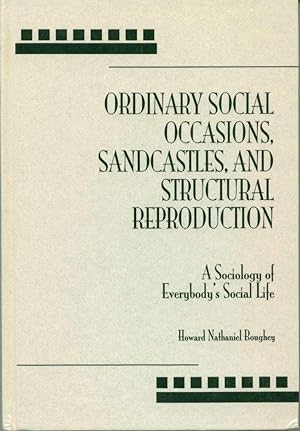
If we look rigorously and systematically, we can see how ordinary people observably strive to reproduce normal social order and sensible social meaning, every day, over and over again. Examination of this "everyday life process" approaches social life as a distinct form of life, the understanding of which begins with discovery of its fundamental principles of organization, those features that characterize it as a distinct form, and those structural elements and dynamics that enable it to sustain its life. These principles are empirically instantiated in naturally occurring, live social occasions.
Using a newly developed hybrid method of interviewing recent ingenuous participants in ordinary occasions to derive detailed descriptions of what they had authentically observed to have been said and done, Boughey develops categories of participant-defined activity modes of identifications.
Most particular and unusual about this approach is its reliance on the testimony of the participants for the definitions, interpretations, and detailed descriptions of what occurred, what it meant, and what the analyst can legitimately make of it. The occasion, its structural parts, and its living processes are all seen and understood primarily as the members' phenomenon, constructed and utilized by them for their own purposes, and only secondarily as useful constructs for the sociologist's purposes. Thus, the scope is to capture a culturally universal specification of the structure and dynamics of human social life.
About the Author
Howard Nathaniel Boughey is Associate Professor of Sociology at the University of Toronto, Canada.
"About this title" may belong to another edition of this title.