
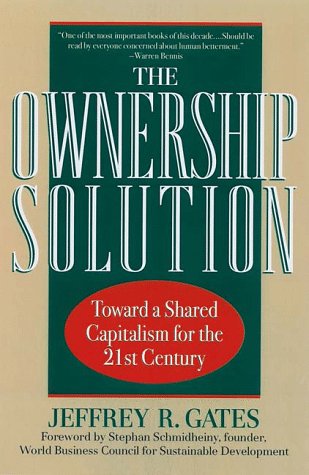
The Ownership Solution: Toward A Shared Capitalism For The Twenty-first Century
Gates, Jeff
ISBN 10: 0201328089 ISBN 13: 9780201328080
Published by Basic Books, 1998
Used
hardcover
From
Half Price Books Inc., Dallas, TX, U.S.A.
Seller rating 5 out of 5 stars

AbeBooks Seller since September 15, 2017
This specific item is no longer available.
About this Item
Description:
Connecting readers with great books since 1972! Used books may not include companion materials, and may have some shelf wear or limited writing. We ship orders daily and Customer Service is our top priority! Seller Inventory # S_450915073
Synopsis:
Capitalism now reigns triumphant—but in the process has created dramatic inequalities of wealth and left many individuals feeling disconnected. Backed by enthusiastic support from a wide array of legislators, corporate leaders, Nobel laureates, environmentalists, and social and political activists, The Ownership Solution shows how to humanize and localize free enterprise by using ownership as a means for engaging more people in its design.
Reviews:
Gates, a lawyer, investment banker, and consultant, finds that although capitalism dominates world economies, it is flawed owing to great inequalities of wealth that are politically and socially unsustainable. What is to be done? More employee-owners must be created, Gates contends, to humanize the free-enterprise system. Earlier solutions, such as ESOP (employee stock option plans), did not catch on. Other approaches must be tried, such as coupling lower corporate taxes, allowing larger depletion allowances, and granting greater earned-income tax credits with broad-based employee ownership. The thrust of Gates's argument is blunted by loose organization and turgid writing. An optional purchase for public policy collections of academic libraries.?Harry Frumerman, formerly with Hunter Coll., New York
Copyright 1998 Reed Business Information, Inc.
Employee ownership of companies has periodically been touted as an incentive that improves morale and productivity. But Gates goes much further. Gates heads his own Atlanta-based consulting firm and is a lawyer who served as counsel to the U.S. Senate Committee on Finance from 1980 to 1987. He advised the committee on pension issues, and he crafted much of that period's legislation designed to encourage employee stock ownership plans (ESOPs). Gates argues that the concentration of capital in the U.S. is now more pronounced than ever before, with ownership mostly in the hands of either a small "aristocracy" or of institutional investors. The result is that investment decisions are "disconnected," not "informed by conscience [nor] made with sensitivity to the community." Gates explains ESOPs and other forms of corporate ownership, analyzes the ownership of capital in other regions of the world, and outlines specifics on how increased individual ownership will help alleviate social and economic problems. David Rouse
"About this title" may belong to another edition of this title.
Bibliographic Details
Title: The Ownership Solution: Toward A Shared ...
Publisher: Basic Books
Publication Date: 1998
Binding: hardcover
Condition: Very Good