About this Item
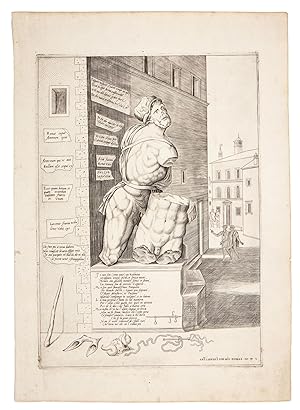
First state. With Lafreri's excudit: "Ant. LafrerI FormIs Romae MDL" at lower right. Watermark "Duck in a Circle"(cf. Woodward 79-80). A fine impression, rich in tone, with light marginal foxing and light soiling, particularly in the lower right corner, and some trivial surface soiling to the image. An iconic image of the statue known as Pasquino, by far the most famous of Rome's 'statue parlanti' (talking statues) and the eponymous originator of the pasquinade genre. The statue was discovered in 1501 in the Parione district of Rome. Cardinal Oliviero Carafa, "the embodiment of humanist ideals, centering on the revival of antiquity"(Reynolds), erected the statue next to his palace near Piazza Navona, on the site of today's Palazzo Braschi, where it stands to this day. As early as 1501, satirical poems in Latin and Italian, variously celebrating or criticizing the pope, clergy, and nobility, or lampooning private individuals, were affixed to the statue. By 1508, the statue had become the focus of a yearly celebration, held on St. Mark's Day, during which the statue was dressed as a Roman deity or other mythological figure, and anonymous writers attached to it poems written in the "voice" of the statue. In 1511, Pasquino was dressed as Grief, mourning the death of Cardinal Carafa. In 1549, the year before this print was published, Pasquino famously opined on the death of Pope Paul III: 'Here was buried a certain Paul/ a fraud, a fox, thief, murderer;/ Here famous in the mouth of Pasquino/ There suffering in the mouth of the devil." The artist responsible for this print has included a number of pasquinades, in Latin and Italian, shown on bits of paper attached to the walls of Carafa's palace. The ground in front of the statue is strewn with props, a reference to the costumes worn by Pasquino during the St. Mark's Day celebration. In the distance are two pairs of men, the first standing in the piazza and the second strolling towards the statue. Carafa's arms are visible in the shadow on the statue's base. Lafreri's print is a close copy of one published in 1542 by Antonio Salamanca, Lafreri's rival and eventual business partner. The identity of the artist is unknown. Among those to whom the plate has been attributed are Enea Vico and Nicolas Beatrizet. In the same year (1550) that he produced his Pasquino print, Lafreri issued a related print, the Marforio, another of Rome's talking statues, with whom Pasquino frequently held "conversations". The origin of the name "Pasquino" has been debated from the very early 16th century, with no definitive conclusion having been reached. The sculpture itself comprises two figures, believed to be either Menelaus cradling the dead Patroclus or Ajax holding the dead Achilles. The primary inscription is a sonetto caudato. Io non son (come paio) un Babbuino stroppiato, senza piedi, et senza mani, Nemen con glialtri membri sconci et strani, La simmia son di Niccolo Zoppino. Ma son quel famosissimo Pasquino Che tremar faccio i Signor piu soprani, et stupir forastieri et Paesani quando compango in volgare, o in Latino. La mia persona è fatta in tal maniera Per i colpi, e, hor questo hor quel in accocca Per ch'io dico i lor falli a buona cera. Ma infin ch'io ha l'usata lingua in bocca Non ne fo stima, anchor che 'l resto pera et sempre cantaro, Zara a chi tocca Che se la gente sciocca Non si vuol rimaner de i falli suoi Chi terrà me' che no 'l ridica poi. I am not (as I seem), a Babbuino crippled, without hands or feet, Nor, with obscene and strange exotic parts, am I the Ape of Nicolò Zoppino, But I am that most famous Pasquino, who makes the most prominent men shiver. and astonishes the out-of-towners and my fellow citizens when I compose in vernacular, or in Latin. My persona was shaped in this way: by the blows I take from here and from there because I reveal their sins, But as long as I have the use of the tongue in my mouth, I do not care, even if the rest of my body perishes, and I will continu.
Seller Inventory # 4841
Contact seller
Report this item