About this Item
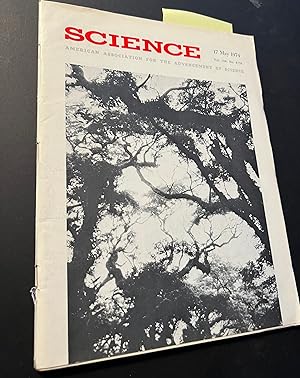
Reid Bryson, "A Perspective on Climate Change" (Science 184 No. 4138 pp. 753-760, May 17, 1974). Full issue, original wrappers. VG copy. A paper by a leading thinker, though now much admired by climate change deniers. [++] "Reid Allen Bryson (1920 2008) was a forceful orator who consistently fought against institutional pressures to get his messages out to the public. In the 1960s, Bryson was a leader in the wider academic turn toward politically charged interdisciplinarianism. To the dismay of many of his colleagues, he publicly made climatological prognoses in the 1970s, becoming a significant figure in the media landscape. He was not swayed by the arguments for global warming, even as the framing became the recognized face of climate change in the late 1980s. By examining the controversies that Bryson instigated and the currents that he swam against, we can see the wider community crystallizing and promoting positions that may have previously gone unstated. In addition, Bryson's personal contribution to the rise of climate discourse has been underexplored in the historical literature. Bryson was instrumental in bringing climate onto the political radar during the World Food Crisis of 1973, shocking both the US and Canadian political establishments into paying more attention to the issue. Bryson's narrative linking climate change to both food supply and a series of climate anomalies in the 1970s remained predominant in the first World Climate Conference of 1979. Bryson also helped break a seal on climatologists speaking directly to the media, leading to unprecedented climate discourse in the 1970s and giving climate change a springboard to become one of the defining issues of the 21st century. ("Reid Bryson: The crisis climatologist" Robert Luke Naylor 2022) [++]"All this argument is the temperature going up or not, it s absurd," Bryson continues. "Of course it s going up. It has gone up since the early 1800s, before the Industrial Revolution, because we re coming out of the Little Ice Age, not because we re putting more carbon dioxide into the air." (Wikipedia) Bryson's views on climate change drew attention and controversy. While he acknowledged the potential influence of human activities on climate, he emphasized the importance of natural climate variability and questioned the extent of human-induced global warming. He argued that climate models at the time did not adequately account for natural factors and criticized the lack of long-term historical climate data. It's important to note that Bryson's views on climate change were not widely accepted within the scientific community. The consensus among climate scientists, as represented by the Intergovernmental Panel on Climate Change (IPCC) and other scientific organizations, supports the understanding that human activities, particularly the emission of greenhouse gases, are the primary drivers of the observed global warming over the past century.
Seller Inventory # ABE-1688174997438
Contact seller
Report this item