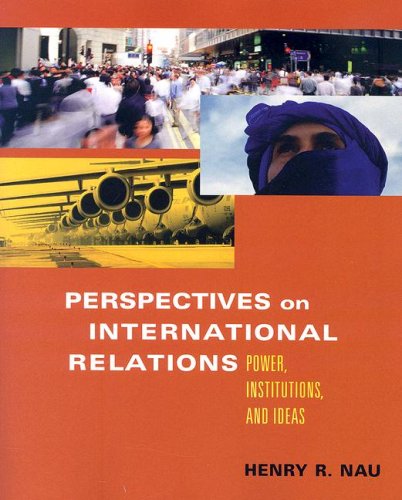
Lauded for its outstanding balance of accessibility and substance, Henry Nau s Perspectives on International Relations lays a real foundation for further study in IR while delivering the critical thinking skills students need to grasp the events unfolding on the world stage. Adopters consistently report that the book s even-handed application of three major viewpoints realism, liberalism, and constructivism is a singularly effective and engaging tool for getting students to understand how the seemingly abstract theories of IR make sense of global events and issues.
While maintaining its brevity and focus, the second edition s revision features the latest in world affairs, advancements in the scholarship, and refined pedagogical features throughout.
New to this edition, in response to user reviews:
- Expanded coverage of Marxism, feminism, soft power, and other perspectives throughout the book and also in Critical Theories sections in each chapter;
- Expanded coverage of key issues in IR: terrorism, ethnic conflict, foreign policy, civil society, global governance, the democratic peace, environmental issues, NGOs, and human security;
- New Spotlight feature highlights the coverage of key ideas and concepts e.g., alliances, balance of power, anarchy so that students digest this information more readily;
- A new, friendlier interior design, including more learning tools, such as a marginal glossary, maps, photos, tables, and figures.
Henry R. Nau has taught political science and served in government for more than thirty years. He is currently Professor of Political Science and International Affairs in the Elliott School of International Affairs at George Washington University, specializing in international relations and U.S. foreign policy.
From 1981 to 1983, he served on the National Security Council as senior director responsible for international economic affairs. He also served, between 1975 and 1977, as Special Assistant to the Under Secretary for Economic Affairs in the Department of State. In 1977 he received the State Department's Superior Honor Award.
His books include At Home Abroad: Identity and Power in American Foreign Policy; Trade and Security: U.S. Policies at Cross-Purposes; The Myth of America's Decline: Leading the World Economy into the 1990s; and National Politics and International Technology: Nuclear Reactor Developments in Western Europe.