Synopsis
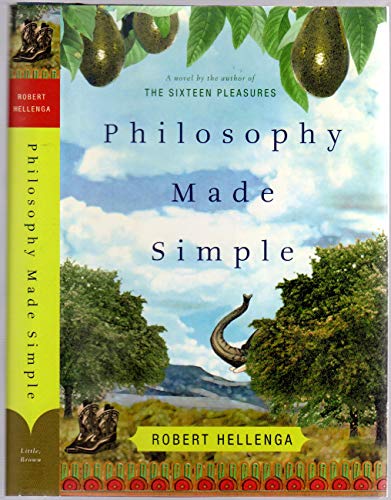
Rudy Harrington has spent half his life in a rambling Chicago house, raising three daughters with his independent-minded wife. But his wife has died, his daughters have moved away, and Rudy is restless. In what he interprets as a moment of transcendent vision, he puts the family home up for sale and buys an avocado grove in Texas. While adapting to his new vocation, new home, and new friends, Rudy takes up a book-Philosophy Made Simple-and begins to struggle with Plato and Aristotle, Hume and Schopenhauer. His newly acquired wisdom is put to the test when he enlists the neighborhood elephant to preside over his daughter+s Hindu wedding and falls in love with the groom+s mother. Hellenga brings back characters from his bestselling The Sixteen Pleasures and introduces many compelling new ones-including the elephant, who paints-in a novel that illuminates our deepest concerns: love and death, marriage and family, and the mysterious tug of beauty on the human heart.
Reviews
Quieter than The Sixteen Pleasures, Philosophy Made Simple is almost—but not quite—as fine a novel. Although it touches on relationships between parents and children, farming, friendship, and life events, the overarching theme speaks to how philosophical beliefs play out in daily life. Hellenga juxtaposes the history of philosophy, from Plato to Kant, with Rudy's search for meaning. This approach, given the seriocomic tone of the novel, seemed artificial to a few critics, smart to some, and oversimplified to others. Despite this divide and a few awkward subplots, Philosophy Made Simple—a poignant fable, really—will charm readers.<BR>Copyright © 2004 Phillips & Nelson Media, Inc.
Riffing off his charming 1994 debut, The Sixteen Pleasures, Hellenga shifts perspective from father to daughter, detailing the former's postmarital adventures as he plans the latter's wedding. It's been seven years since the death of Rudy Harrington's beloved wife, Helen; his three daughters have flown the coop; and the time is ripe to sell his Chicago home of 30 years and buy an avocado grove in Texas. He's also been reading the college-level text Philosophy Made Simple by Siva Singh, his daughter Molly's fiancé's uncle, sparking a previously latent interest in life's big questions. Rudy attempts, at 60, to adjust to single life while singlehandedly planning an Indian wedding for Molly to Singh's nephew, TJ. His grove manager, Medardo, takes him on weekend trips to a Mexican gentleman's club; there, he meets Maria, an employee with a penchant for weakhearted middle-aged men. A denizen of a nearby trailer park is Norma Jean, a lovable elephant with a tremendous talent for painting. When Molly, TJ, Siva and Nandini (Siva's sister and TJ's mother) arrive, Nandini is as taken with Norma Jean, whose owner is suddenly MIA, as is Rudy. More twinkly humor, mild insight, clean prose and gentle homilies follow in this thinker's light gem. (Mar. 8)
Copyright © Reed Business Information, a division of Reed Elsevier Inc. All rights reserved.
*Starred Review* Rudy, a Chicago avocado wholesaler, is haunted by the death of his wife. He immerses himself in a book titled Philosophy Made Simple, then abruptly sells his beloved family home and buys a Texas avocado grove, much to the consternation of his daughters: attorney Meg; Molly, a dancer engaged to TJ, a scientist from India; and Margot, a book conservator and the star of Hellenga's best-selling The Sixteen Pleasures (1994). No need to have read the earlier work to become enthralled by this psychologically suspenseful tale, but no fiction lover should miss it. Hellenga possesses an exceptionally magnetic voice, enabling him to draw readers in with charm, then hand them profundity. Alone in his new digs, Rudy feels adrift in a strange and confounding world. A Christian radio station declares the Second Coming. An elephant named Norma Jean paints beautiful, brilliantly hued abstract compositions. Rudy befriends a priest without a congregation and learns about the Hindu elephant god Ganesh as he plans Molly and TJ's wedding. He also has visions, develops heart trouble, and falls in love. Supremely wily and compelling, Hellenga turns a human tale of reason versus feeling into a cosmic playoff between order and chaos. Donna Seaman
Copyright © American Library Association. All rights reserved
"About this title" may belong to another edition of this title.