
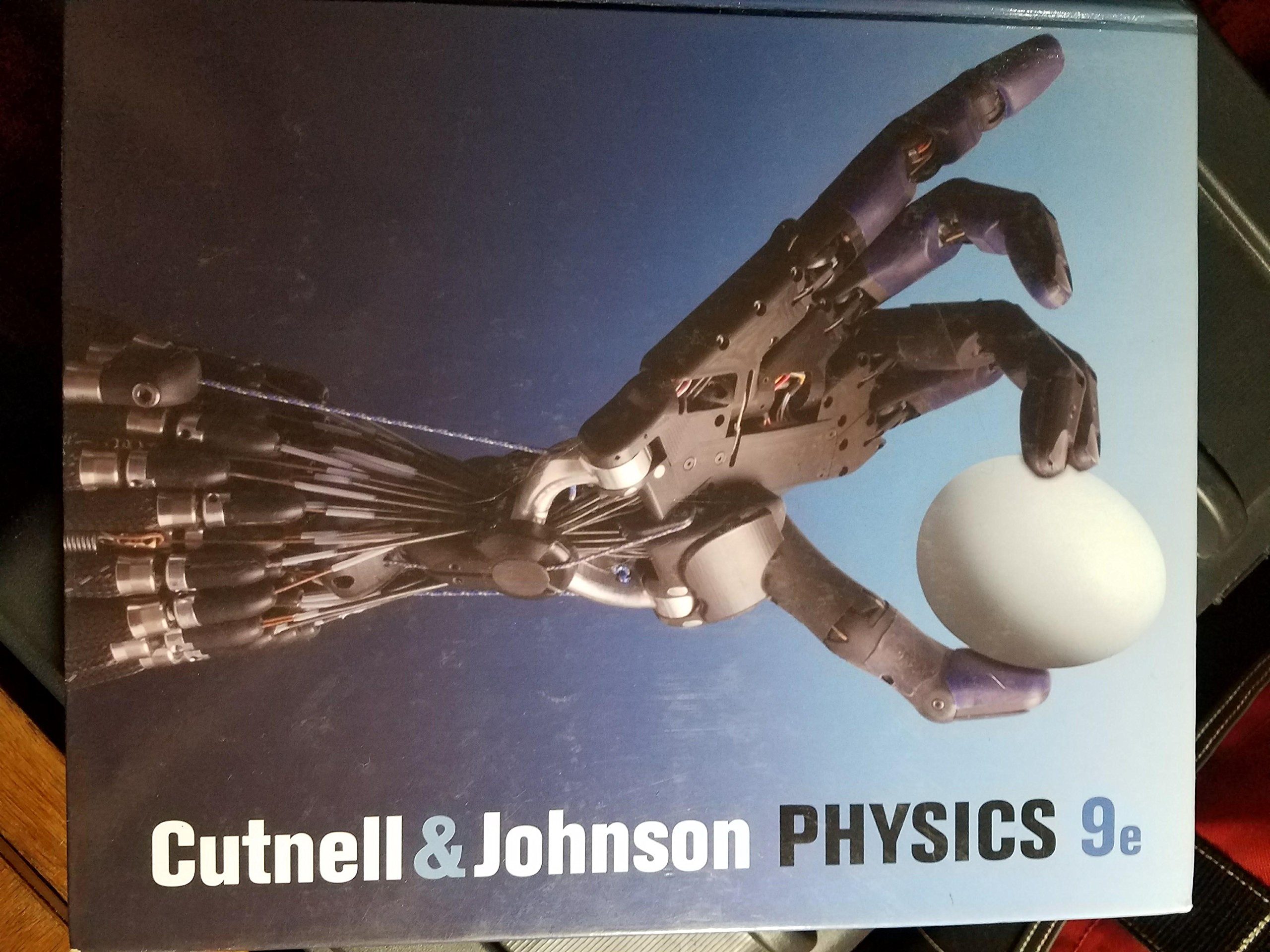

Physics, 9th Edition
Cutnell, John D.; Johnson, Kenneth W.
ISBN 10: 0470879521 ISBN 13: 9780470879528
Published by John Wiley and Sons, 2012
Used
Hardcover
From
Zoom Books Company, Lynden, WA, U.S.A.
Seller rating 5 out of 5 stars

AbeBooks Seller since December 19, 2022
This specific item is no longer available.
About this Item
Description:
Book is in good condition and may include underlining highlighting and minimal wear. The book can also include "From the library of" labels. May not contain miscellaneous items toys, dvds, etc. . We offer 100% money back guarantee and 24 7 customer service. Seller Inventory # ZBV.0470879521.G
Synopsis:
Cutnell and Johnson has been the #1 text in the algebra-based physics market for almost 20 years. PHYSICS 9e continues that tradition by providing superior support students need to facilitate a deeper level of conceptual understanding, improve their reasoning skills and see the relevance of physics to their lives and future careers.
Research studies have shown that there is a strong correlation between time on task and student learning gains. PHYSICS 9e with WileyPLUS offers instructors innovative new tools for engaging students. Through the use of a proven pedagogy that includes integrated reading activities, instructors are able to much more effectively monitor student reading and progress, resulting in a higher level of student engagement with the course content.
Success in physics is also based on practice. Working high quality problem sets is one of the best ways for students to learn physics. However, to get the greatest benefit from working problems students need immediate feedback and expert coaching. PHYSICS 9e with WileyPLUS offers an extensive and tested set of assessment questions and sophisticated wrong answer feedback.
Access to WileyPLUS not included with this textbook.
This text features:
Review:
Test Your Physics Knowledge:
- Yes/No
- In steady flow, the velocity v of a fluid particle at any point is constant in time. On the other hand, the fluid in a pipe accelerates when it moves from a larger-diameter section of the pipe into a smaller-diameter section, so the velocity is increasing during the transition. Does the condition of steady flow rule out such an acceleration?
- Suppose that you stand in front of a spherical mirror (concave or convex). Is it possible for your image to be (a) real and upright (b) virtual and inverted?
- Is the acceleration of a projectile equal to zero when the projectile reaches the top of its trajectory?
- On a distant asteroid, a large catapult is used to throw chucks of stone into space. Could such a device be used as a propulsion system to move the asteroid closer to the earth?
- Physics Problems
- The corners of a square lie on a circle of diameter D = 0.35 m. Each side of the square has a length L. Find L.
- The temperatures indoors and outdoors are 299 and 312 K, respectively. A Carnot air conditioner deposits 6.12 x 10⁵ J of heat outdoors. How much heat is removed from the house?
- Multiple Choice
- A net external nonconservative force does positive work on a particle. Based solely on this information, you are justified in reaching only one of the following conclusions. Which one is it?
- The kinetic and potential energies of the particle both decrease
- The kinetic and potential energies of the particle both increase
- Neither the kinetic nor the potential energy of the particle changes
- The total mechanical energy of the particle decreases
- The total mechanical energy of the particle increases
- Is it possible for the temperature of a substance to rise without heat flowing into the substance?
- Yes, provided that the volume of the substance does not change
- Yes, provided that the substance expands and does positive work
- Yes, provided that work is done on the substance and it contracts
- Which of the following statements can be explained by Newton’s forst law? (A): When your car suddenly comes to a halt, you lunge forward. (B): When your car rapidly accelerates, you are pressed backward against the seat.
- Neither A nor B
- Both A and B
- A but not B
- B but not A
- The transfer of heat by convection is smallest in __________.
- Solids
- Liquids
- Gasses
- One day during the winter the sun has been shining all day. Toward sunset a light snow begins to fall. It collects without melting on a cement playground, but melts instantly on contact with a black asphalt road adjacent to the playground. Why the difference?
- Being black, asphalt has a higher emissivity than cement, so the asphalt absorbs more radiant energy from the sun during the day and, consequently, warms about the freezing point.
- Being black, asphalt has a lower emissivity than cement, so the asphalt absorbs more radiant energy from the sun during the day and, consequently, warms about the freezing point.
Answers:
- Yes/No
- No
- a. No - b. No
- No
- Yes
- Physics Problems
- 0.25 m
- 5.86 x 10⁵ J
- Multiple Choice
- e
- c
- b
- a
- a
"About this title" may belong to another edition of this title.
Bibliographic Details
Title: Physics, 9th Edition
Publisher: John Wiley and Sons
Publication Date: 2012
Binding: Hardcover
Condition: good