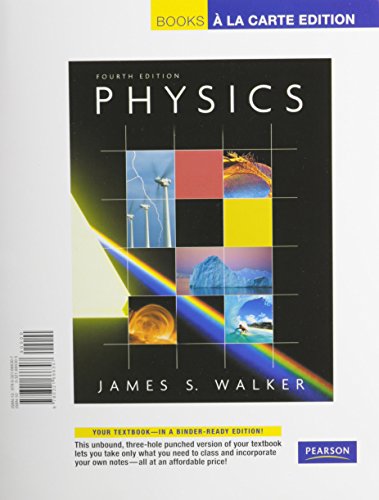
The market leader for the first-year physics laboratory course, this manual offers a wide range of class-tested experiments designed explicitly for use in small to mid-size lab programs. The manual provides a series of integrated experiments that emphasize the use of computerized instrumentation.
The Sixth Edition includes a set of "computer-assisted experiments" that allow students and instructors to use this modern equipment. This option also allows instructors to find the appropriate balance between traditional and computer-based experiments for their courses. By analyzing data through two different methods, students gain a greater understanding of the concepts behind the experiments.
- The manual includes 14 integrated experiments?computerized and traditional?that can also be used independently of one another. Ten of these integrated experiments are included in the standard (bound) edition; four are available for customization.
- Instructors may elect to customize the manual to include only those experiments they want. The bound volume includes the 33 most commonly used experiments that have appeared in previous editions; an additional 16 experiments are available for examination online. Instructors may choose any of these experiments?49 in all?to produce a manual that explicitly matches their course needs.
- Each experiment includes six components that aid students in their analysis and interpretation: Advance Study Assignment, Introduction and Objectives, Equipment Needed, Theory, Experimental Procedures, and Laboratory Report and Questions.
Jerry Wilson received his physics degrees from Ohio University (B.S., Ph.D.) and Union College in Schenectady, New York (M.S.). In addition to co-writing PHYSICS LABORATORY EXPERIMENTS, he is one of the original authors of the first edition of AN INTRODUCTION OF PHYSICAL SCIENCE (published in 1971) and has several other physics textbooks to his credit. Wilson is currently Emeritus Professor of Physics at Lander University in Greenwood, South Carolina.
Cecilia Hernández-Hall received her M.S. in physics from the University of Puerto Rico, Mayagüez Campus, in 1993. After teaching for two years at the Mayagüez and Cayey campuses, she joined the Physics Education Research Group at the University of Nebraska, Lincoln, where research in physics education was conducted with an emphasis on computerized instruction. Professor Hernández has used computerized instruction with hundreds of her students, and she contributes to the computerized-instruction material throughout PHYSICS LABORATORY EXPERIMENTS. In 1998, Professor Hernández joined the faculty of American River College. She also works for PASCO Scientific in Roseville, California, where she helps develop computer-assisted lab activities for college physics and write manuals for new equipment.