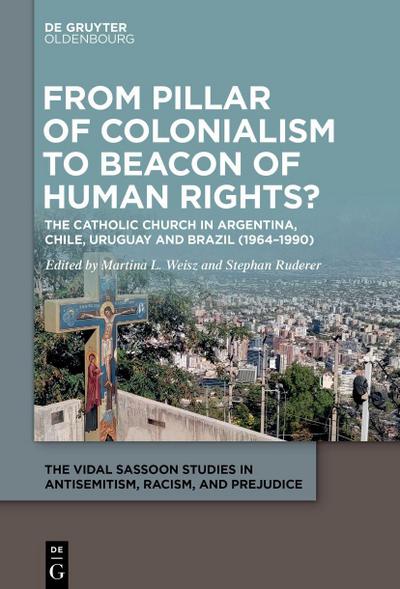
From Pillar of Colonialism to Beacon of Human Rights?
Martina L. Weisz
Sold by Books-by-Floh, Paderborn, Germany
AbeBooks Seller since March 13, 2026
New - Hardcover
Condition: New
Ships from Germany to U.S.A.
Quantity: 2 available
Add to basketSold by Books-by-Floh, Paderborn, Germany
AbeBooks Seller since March 13, 2026
Condition: New
Quantity: 2 available
Add to basketNeuware -In the Southern Cone and Brazil the democratization processes that began in the mid-1980s led to numerous investigations into the most complex and dire episodes in the region's history. This process followed the dismantling of brutal dictatorial regimes and was aided by the declassification of new documents, opening new paths for historians to understand the recent past.The role played by the Catholic Church in this period is crucial, given the fact that since the 15th century, when it stood as one of the pillars of the colonial order in Latin America, it remained a key player in Latin American culture and politics, through a successful adaptation to the spirit of the times.Hence, its study is key to assess the impact that the values of democratization and human rights had in this part of the world during the Cold War, andto understandthe continuities in the patterns of inequality, violence and racism inherited from colonial times.In this volume, we seek to shed light on the challenges and dilemmas faced by the Catholic Church in the Southern Cone and Brazil between ca.1964 and 1990, using new archival work.The year 1964 is the year where the dictatorial wave in the region began in Brazil, and 1990 is the year that sealed the period, with the fall of the Pinochet government in Chile. 280 pp. Englisch.
Seller Inventory # 9783119148726
In the Southern Cone and Brazil the democratization processes that began in the mid-1980s led to numerous investigations into the most complex and dire episodes in the region’s history. This process followed the dismantling of brutal dictatorial regimes and was aided by the declassification of new documents, opening new paths for historians to understand the recent past.
The role played by the Catholic Church in this period is crucial, given the fact that since the 15th century, when it stood as one of the pillars of the colonial order in Latin America, it remained a key player in Latin American culture and politics, through a successful adaptation to the spirit of the times. Hence, its study is key to assess the impact that the values of democratization and human rights had in this part of the world during the Cold War, and to understand the continuities in the patterns of inequality, violence and racism inherited from colonial times.
In this volume, we seek to shed light on the challenges and dilemmas faced by the Catholic Church in the Southern Cone and Brazil between ca. 1964 and 1990, using new archival work. The year 1964 is the year where the dictatorial wave in the region began in Brazil, and 1990 is the year that sealed the period, with the fall of the Pinochet government in Chile.
Martina L. Weisz, The Hebrew University of Jerusalem, Israel; Stephan Ruderer, Pontificia Universidad Católica de Chile, Santiago.
"About this title" may belong to another edition of this title.
** ENGLISH at the BOTTOM **
Allgemeine Geschäftsbedingungen
Inhaltsverzeichnis
1.Geltungsbereich
Für alle Bestellungen über die Abebooks bzw. ZAVB Webseite durch Verbraucher und Unternehmer gelten die nachfolgenden AGB....
| Order quantity | 60 to 60 business days | 60 to 60 business days |
|---|---|---|
| First item | US$ 119.61 | US$ 148.08 |
Delivery times are set by sellers and vary by carrier and location. Orders passing through Customs may face delays and buyers are responsible for any associated duties or fees. Sellers may contact you regarding additional charges to cover any increased costs to ship your items.