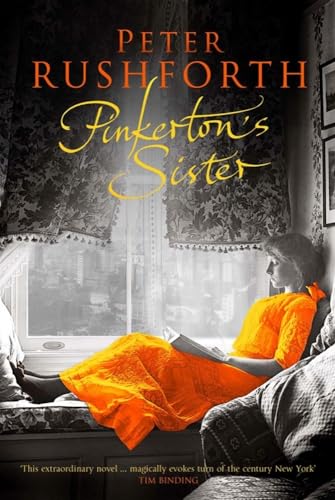
It's turn-of-the-century New York, a city bursting with new life as the old century's order makes way for the mercantile class. But in the Pinkerton household a nineteenth-century embarrassment remains. Alice Pinkerton. Alice isn't mad exactly, but she's not sane either. She is tolerated, free to wander about, free to accompany her family to tea parties - free to be treated like a simpleton. But in truth Alice's mind is razor sharp, honed by a restless imagination, years of reading and a profound contempt for her surroundings. Left alone to read, to think, she has devoured the world that brings her mind alive: Shakespeare, Oscar Wilde, Michelangelo, Whitman, Poe, they are her inspiration; Jane Eyre, Catherine Moreland, Desdemona her companions. As she moves through the witless world around her, observing its prejudices, its shallow culture and its vanity, it is society that prompts her observations, viewing all through the prism of the art that has sustained and nourished her lonely life.
Within the bounds of realism, a more fantastic or original novel than Peter Rushforth's
Pinkerton's Sister would be hard to imagine. Alice Pinkerton is a New York spinster of 1905, raised to join the middle-class matrons in her respectable, status-conscious neighborhood, but cursed from childhood with the gift of seeing through humbug. Her ecstatic immersion in English literature has only made things worse, so that by the age of 30, she is too clever, quirky, and dark-mustached to be anything but an object of scorn in the eyes of her peers. When not submitting to her psychologist's latest enthusiasms (she suffers his passing fancies for phrenology, massage, hot water immersion, cold water immersion, dream interpretation, cloud reading, and hypnosis) Alice occupies herself with word games and arabesques, indulging in lengthy fantasies of gender-reversal, spontaneous ballet, and other embarrassments for the doctors, clergymen, merchants, and matrons who patrol the social boundaries that keep bluestockings like Alice locked away as "madwomen," rather than writing and selling books.
There's very little in the way of plot in Rushforth's second novel (the first, Kindergarten, appeared to acclaim about 25 years ago), except for the piecemeal recollection of her childhood friendship with a black servant named Annie. Not much older than Alice herself, Annie was a worthy playmate who tried to protect Alice from her father and the never-spelled-out abuses he and a friend inflicted on them both. Alice's hatred of her father burns even hotter than her love of Annie, and she remains convinced he was responsible for Annie¹s disappearance and probable death. These passions--and a handful of other childhood memories--hold together an otherwise loose, disorderly sequence of satirical jokes and verbal flourishes and sometimes overly long frolics. Don't expect the rustling skirts and repressed emotions of a Merchant Ivory film. Pinkerton's Sister reads like an absinthe-fueled, all-night collaboration between Edith Wharton, Angela Carter, and Monty Python. --Regina Marler