Synopsis
There are many planetary systems other than our own, but it is only through a detailed understanding of the relatively accessible bodies in our solar system that a thorough appreciation of planetary science can be gained. This is particularly pertinent with the recent discovery of extra-solar planets and the desire to understand their formation and the prospect of life on other worlds.
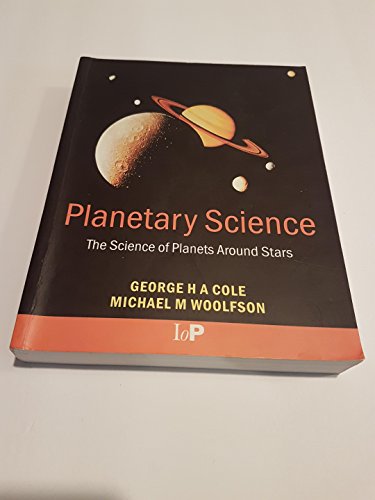
Planetary Science: The Science of Planets Around Stars focuses on the structure of planets and the stars they orbit and the interactions between them. The book is written in two parts, making it suitable for students at different levels and approaching planetary science from differing backgrounds. Twelve independent descriptive chapters reveal our solar system and the diverse bodies it contains, including satellites, planetary rings, asteroids, comets, meteorites, and interstellar dust. These chapters are accompanied by 42 detailed topics that discuss specialized subjects in a quantitative manner and will be essential reading for those in higher level courses. Coverage includes mineralogy, stellar formation and evolution, solar system dynamics, atmospheric physics, planetary interiors, thermodynamics, planetary astrophysics, and exobiology. Problems and answers are also included.
Planetary Science: The Science of Planets Around Stars presents a complete overview of planetary science for students of physics, astronomy, astrophysics, earth sciences, and geophysics. Assuming no prior knowledge of astrophysics or geophysics, this book is suitable for students studying planetary science for the first time.
Review
This is a strong contender for a text suitable for an undergraduate course in planetary science ... pitched at exactly the right level for an undergraduate physics or astronomy student ... At the end of each chapter and topic there are one or two problems, well chosen to illustrate the material and to reinforce the reader's understanding ... if I were teaching a course on the solar system, I would certainly have this book on my desk and use it frequently.
- Jeremy B. Tatum, The Observatory
... a useful contribution to the literature ... The figures are clear and there are a few colour plates. The chapters and most of the topics end with one or two questions to which full answers are given - a welcome feature.
- Professor B.W. Jones, Contemporary Physics, 2003, vol. 44, no. 1
... good textbooks have been rare indeed, so this new edition by two eminent British professors of the subject is more than welcome, not just because it is overdue, but because it is excellent, one of the best in what is still a very limited field. It's quality derives from the broadly-based knowledge of the authors, and their consequent ability to expound on a wide range of topics ... Best of all, they stick closely to the physics, and the treatment is richly quantitative, complete with problems at the end of each section... Care is taken throughout, even in the title of the book, to emphasize the universality of the principles involved ... Overall, this is the book for anyone involved in teaching, or learning, the science of planets around stars.
- F.W. Taylor, University of Oxford, Surveys in Geophysics
Their book elegantly combines physics, mathematics, geophysics and astronomy ...The second part is refreshingly unusual, concentrating on 41 planetary science topics ... The mathematical and physical approach is elegant, relevant and at a typical second-year university level. This book encourages understanding and not mere assimilation of data.
-David Hughes, New Scientist, March 2003
The authors take the information we know of our Solar System to form the basis of a generalized planetary science, which can then be applied to any external star system... The material would be appealing to students in physics, astronomy, geology or other science majors looking for a comprehensive overview of planetary science. Even though this book is meant to be used as a textbook, the interested individual will find it engaging and instructive. Highly recommended for academic collections.
-E-STREAMS, Vol. 5, No. 11
Overall the book achieves its goal of providing a basic text in planetary science, while providing instructors a fair amount of flexibility in drawing basic course material from the text, as well as providing a useful reference for students. It also has a relatively large number of problems and exercises to illustrate the basic concepts ... the book is quite useful as is, and could very nicely serve as a basic text on which to build an advanced undergraduate or graduate-level course in planetary science.
-Robert H. Brown, Departments of Planetary Sciences and Astronomy, University of Arizona, USA
"About this title" may belong to another edition of this title.