
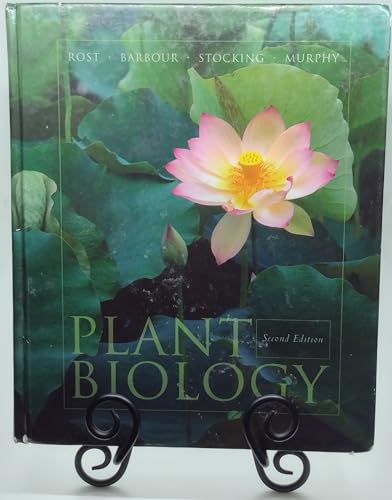
Plant Biology
Murphy, Terence M., Rost, Thomas L., Stocking, C. Ralph, Barbour, Michael G.
ISBN 10: 0534380611 ISBN 13: 9780534380618
Published by Brooks/Cole, 2005
Used
Hardcover
From
Better World Books: West, Reno, NV, U.S.A.
Seller rating 5 out of 5 stars

AbeBooks Seller since March 14, 2016
This specific item is no longer available.
About this Item
Description:
Pages intact with possible writing/highlighting. Binding strong with minor wear. Dust jackets/supplements may not be included. Stock photo provided. Product includes identifying sticker. Better World Books: Buy Books. Do Good. Seller Inventory # 5953347-75
Synopsis:
PLANT BIOLOGY, Second Edition provides a complete introduction to the science of plants, combining the most current, real-world examples with information on plant biodiversity and ecology, including topics like biotechnology, economic botany, and plant/human interactions. PLANT BIOLOGY begins with elements of botany that are most familiar to students: the structure, function, reproduction, physiology, and genetics of flowering plants. The evolutionary survey is then presented, with detail on the Prokaryotes, Protists, Fungi, Bryophytes, early Tracheophytes, Gymnosperms, and Angiosperms. The overall sequence of subjects builds from metabolism and plant function to reproduction, then from simpler to more advanced organisms, concluding with two ecological chapters. Each chapter has been written in a modular fashion, however, to allow them to be taught in any order. In this new edition, the biodiversity chapters provide the best-supported, most current phylogenetic view of the organisms. C
About the Authors:
Thomas L. Rost is a professor of plant biology at the University of California, Davis and is currently the Executive Associate Dean there in the Division of Biological Sciences. He received his B.S. in biology from St. John's University, his M.A. in biology from Mankato State University, and his Ph.D. in botany from Iowa State University. He has taught developmental plant anatomy for almost 30 years. His primary research interests include the structure and development of roots in vascular plants and structural aspects of Pierce's disease in grape vines.
Michael Barbour is a plant ecologist in the Environmental Horticulture Department at the University of California, Davis. His research blends ecophysiology, population biology, and vegetation science. His current research projects include a state-wide survey of vernal pool vegetation in California for conservation purposes, a search for vegetation and soil traits that define "old-growth" status for montane mixed conifer forest and a continuum of values for those traits that correlate with successional distance from old-growth status, and a reconstruction of pre-contact old-growth Californian mixed conifer forest. These projects have been supported by the USDA Forest Service, the National Science Foundation, the Packard Foundation, the California Department of Fish and Game, and the California Department of Transportation.
Ralph Stocking received his degrees in plant nutrition and plant physiology from University of California, Berkeley and University of California, Davis. His research background concerns water relations of plants, photosynthesis, and chloroplast structure and development, on which subjects he has published over 80 scientific papers. He has also been a coauthor of nine editions of the UC Davis series of botany/plant biology books.
Terence Murphy is a professor of plant biology at the University of California, Davis. He received his Ph.D. from the University of California, San Diego in cell biology, and has taught courses in introductory biology, plant physiology, and plant molecular biology. His research areas include the effects of stress on plant cells, particularly on DNA, membrane transport, and oxygen metabolism. Terence Murphy has over 30 years of experience teaching introductory biology courses.
"About this title" may belong to another edition of this title.
Bibliographic Details
Title: Plant Biology
Publisher: Brooks/Cole
Publication Date: 2005
Binding: Hardcover
Condition: Very Good
Edition: 2nd Edition.