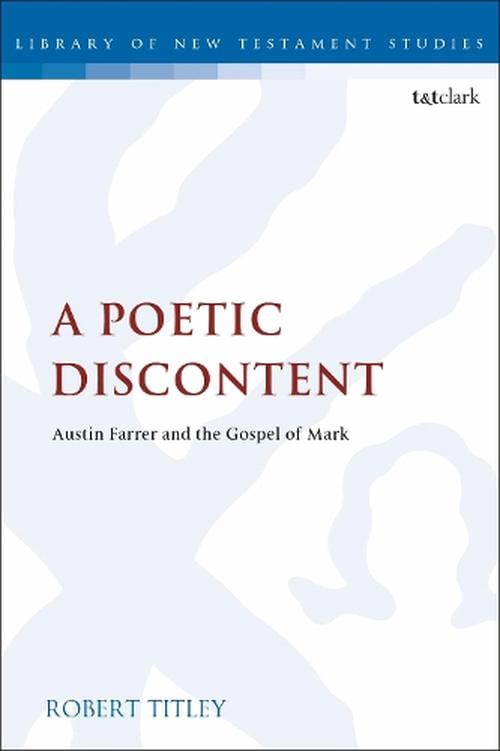
A Poetic Discontent (Paperback)
Rev Robert Titley
Sold by Grand Eagle Retail, Bensenville, IL, U.S.A.
AbeBooks Seller since October 12, 2005
New - Soft cover
Condition: New
Ships within U.S.A.
Quantity: 1 available
Add to basketSold by Grand Eagle Retail, Bensenville, IL, U.S.A.
AbeBooks Seller since October 12, 2005
Condition: New
Quantity: 1 available
Add to basketPaperback. Austin Farrer has often been described as the one genius that the Church of England produced in the twentieth century. He wrote and spoke widely as a philosophical theologian, a biblical scholar and as a preacher. Farrer's philosophical work is read widely and some of his sermons are still in print, forty years after his death. His biblical writings, however, have been largely ignored, even at the time they were written. Robert Titley asks whether, in respect of his work on the Gospel of Mark, this neglect is justified. Titley's approach is from three angles, looking at Farrer on Mark as literature, as history, and as scripture. Farrer's reflections are far from simple, and they show that these apparently simple categories, 'Literature', 'History' and 'Scripture', are themselves in need of refinement if they are not to mislead. Titley examines two major texts of Farrer's: his 1948 Bampton Lectures, published as The Glass of Vision, and his A Study in St Mark (1951). Other works, notably his second look at Gospel interpretation, St Matthew and St Mark (1954), and several lectures, articles and sermons, are also significant. Farrer's essential observation about Mark (and other biblical writings) is that they are the products of creative, 'poetic' minds. Titley argues that, while Farrer makes an error in treating Mark as poetry rather than prose narrative, he nevertheless shows remarkable prescience when his work is viewed in the light of the subsequent emergence of a 'literary paradigm' in Gospel interpretation. In particular, Titley demonstrates that a conversation with Farrer's work has something to contribute to the continuing debate about whether - and, if so, how - to take account of authorial intention in reading a text, and about what significance - if any - can be given to statements about what a text 'means.' This item is printed on demand. Shipping may be from multiple locations in the US or from the UK, depending on stock availability.
Seller Inventory # 9780567688934
Austin Farrer has often been described as the one genius that the Church of England produced in the twentieth century. He wrote and spoke widely as a philosophical theologian, a biblical scholar and as a preacher. Farrer's philosophical work is read widely and some of his sermons are still in print, forty years after his death. His biblical writings, however, have been largely ignored, even at the time they were written. Robert Titley asks whether, in respect of his work on the Gospel of Mark, this neglect is justified. Titley's approach is from three angles, looking at Farrer on Mark as literature, as history, and as scripture. Farrer's reflections are far from simple, and they show that these apparently simple categories, 'Literature', 'History' and 'Scripture', are themselves in need of refinement if they are not to mislead.
Titley examines two major texts of Farrer's: his 1948 Bampton Lectures, published as The Glass of Vision, and his A Study in St Mark (1951). Other works, notably his second look at Gospel interpretation, St Matthew and St Mark (1954), and several lectures, articles and sermons, are also significant. Farrer's essential observation about Mark (and other biblical writings) is that they are the products of creative, 'poetic' minds. Titley argues that, while Farrer makes an error in treating Mark as poetry rather than prose narrative, he nevertheless shows remarkable prescience when his work is viewed in the light of the subsequent emergence of a 'literary paradigm' in Gospel interpretation. In particular, Titley demonstrates that a conversation with Farrer's work has something to contribute to the continuing debate about whether - and, if so, how - to take account of authorial intention in reading a text, and about what significance - if any - can be given to statements about what a text 'means.'
"About this title" may belong to another edition of this title.
We guarantee the condition of every book as it¿s described on the Abebooks web sites. If you¿ve changed
your mind about a book that you¿ve ordered, please use the Ask bookseller a question link to contact us
and we¿ll respond within 2 business days.
Books ship from California and Michigan.
Orders usually ship within 2 business days. All books within the US ship free of charge. Delivery is 4-14 business days anywhere in the United States.
Books ship from California and Michigan.
If your book order is heavy or oversized, we may contact you to let you know extra shipping is required.
| Order quantity | 6 to 16 business days | 6 to 14 business days |
|---|---|---|
| First item | US$ 0.00 | US$ 0.00 |
Delivery times are set by sellers and vary by carrier and location. Orders passing through Customs may face delays and buyers are responsible for any associated duties or fees. Sellers may contact you regarding additional charges to cover any increased costs to ship your items.