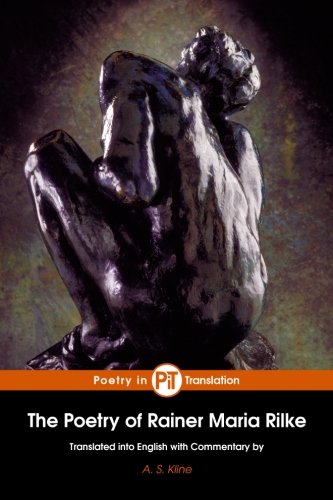
The Poetry of Rainer Maria Rilke
Rilke, Rainer Maria; Kline, A. S.
Sold by BooksRun, Philadelphia, PA, U.S.A.
AbeBooks Seller since February 2, 2016
Used - Soft cover
Condition: Used - Fair
Ships within U.S.A.
Quantity: 1 available
Add to basketSold by BooksRun, Philadelphia, PA, U.S.A.
AbeBooks Seller since February 2, 2016
Condition: Used - Fair
Quantity: 1 available
Add to basketThe item might be beaten up but readable. May contain markings or highlighting, as well as stains, bent corners, or any other major defect, but the text is not obscured in any way.
Seller Inventory # 1512129461-7-1
The Poetry of Rainer Maria Rilke. A translation into English with Commentary by A. S. Kline. Illustrated with photographs of the sculpture of Auguste Rodin.
This compilation comprises:
Rainer Maria Rilke, was born in Prague, the capital of Bohemia, in 1875. He studied in Prague and Munich before travelling widely. In 1902 he arrived in Paris, where he subsequently became Auguste Rodin’s secretary. It was here that he developed the more objective style of his collection New Poems (Neue Gedichte, 1907).
During the winter of 1911/1912 Rainer Maria Rilke was invited to Castle Duino, near Trieste, where he began the Duino Elegies. The work would, however, remain unfinished for a decade. Creatively muted by bouts of depression, in part caused by the First World War, Rilke did not complete the Elegies until 1922. His Sonnets to Orpheus were written in the same year during a three-week paroxysm of creativity.
The Duino Elegies and Sonnets to Orpheus deploy and extend both his early lyrical gifts and subsequently more objective formal style in a poetry of philosophical and spiritual depth, centred around a view of life and death as forming a complete whole, and demanding a full human response to both the positive and negative aspects of both these ‘realms’. In that sense he is a poet of both darkness and light, of the bleak and sparse but also the spiritual and consolatory. Ideas from late nineteenth century existentialist philosophy, the influence of artists like Rodin and Picasso, and a subtle awareness of Psychology as a developing area of intellectual exploration, can all be found in his work, while his spiritual and poetic world is revealed as both highly individualistic and profoundly modernistic, despite its Romantic lyrical heritage.
Published by Poetry in Translation.
"About this title" may belong to another edition of this title.
30 days hassle-free returns guaranteed!
| Order quantity | 3 to 8 business days | 3 to 6 business days |
|---|---|---|
| First item | US$ 0.00 | US$ 3.99 |
Delivery times are set by sellers and vary by carrier and location. Orders passing through Customs may face delays and buyers are responsible for any associated duties or fees. Sellers may contact you regarding additional charges to cover any increased costs to ship your items.