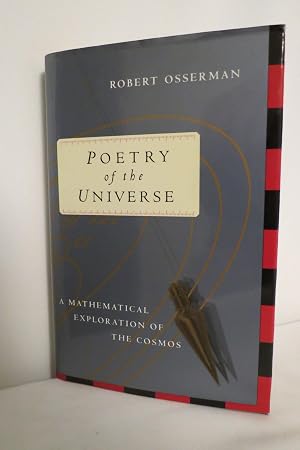
Poetry of the Universe: A Mathematical Exploration of the Cosmos
297 ratings by Goodreads
Language: English
Published by Doubleday, 1995
- Hardcover
- Used

Seller: Greenworld Books, arlington, TX, U.S.A.Greenworld Books
5-star seller
AbeBooks seller since June 20, 2025
Hardcover
Condition: Used - Good
US$ 4.92
Free Shipping
Ships within U.S.A.
Quantity: 1 available
Add to basketFree 30-day returns
Item description from seller
Fast Free Shipping â Good condition. It may show normal signs of use, such as light writing, highlighting, or library markings, but all pages are intact and the book is fully readable. A solid, complete copy that's ready to enjoy.
Seller Inventory # GWV.0385473400.G
- Title
- Poetry of the Universe: A Mathematical Exploration of the Cosmos
- Author
- Osserman, Robert
- Publisher
- Doubleday
- Publication year
- 1995
- Condition
- good
- Binding
- Hardcover
- Language
- English
- ISBN 10
- 0385473400
- ISBN 13
- 9780385473408
Using illustrations and a minimum of mathematical formulas, a narrative journeys from ancient Greece to recent discoveries about background radiation in space to illuminate the interplay between mathematical theory and attempts to unlock the secrets of the universe
"Synopsis" may belong to another edition of this title.
Reviews
This short, delightful book is essential reading for those educated in the liberal and fine arts who have never had the opportunity to appreciate the beauty of mathematics and physics. Osserman, a Stanford University professor who developed a math and physics course for humanities majors, manages to convey some of the fascination of these two fields without getting involved in technical details and without talking down to his audience. His seamless development leads the reader almost effortlessly from the early efforts of the ancients to measure the earth through the open problems in modern cosmology. Strongly recommended.
Harold D. Shane, Baruch Coll., CUNY
Copyright 1995 Reed Business Information, Inc.
With nary an equation to confuse, a Stanford math professor clearly distills for a general readership the seminal ideas behind the notion that space has curvature and is not flat as ordinary humans perceive it. Osserman has been working up to this book through his classes for humanities majors, and the result is as lucid, comprehensible, and engaging as will be found in this category of scientific writing. He begins with ancient measurements of the earth, in which Euclid's geometry figures critically, but reaches cruising speed in his presentations of the nineteenth-century German mathematicians Carl Friedrich Gauss and Georg Friedrich Riemann. They are the best-known inventors of non-Euclidean geometry, whose commonest concept is that not all angles of all triangles add up to 180; the sum depends on the curvature of the surface in question. The ramifications cascade from there, into the shape of the retroverse, as the author tags our celestial view back into time and on toward invented abstract multidimensional shapes dubbed manifolds. Libraries know the popularity of sagas on observational astronomy and particle physics, and this examination of the mathematical component, specifically the species of geometry, fits well within their compass. A warm invitation to the aesthetics of math on the largest scale. Gilbert Taylor
Harold D. Shane, Baruch Coll., CUNY
Copyright 1995 Reed Business Information, Inc.
With nary an equation to confuse, a Stanford math professor clearly distills for a general readership the seminal ideas behind the notion that space has curvature and is not flat as ordinary humans perceive it. Osserman has been working up to this book through his classes for humanities majors, and the result is as lucid, comprehensible, and engaging as will be found in this category of scientific writing. He begins with ancient measurements of the earth, in which Euclid's geometry figures critically, but reaches cruising speed in his presentations of the nineteenth-century German mathematicians Carl Friedrich Gauss and Georg Friedrich Riemann. They are the best-known inventors of non-Euclidean geometry, whose commonest concept is that not all angles of all triangles add up to 180; the sum depends on the curvature of the surface in question. The ramifications cascade from there, into the shape of the retroverse, as the author tags our celestial view back into time and on toward invented abstract multidimensional shapes dubbed manifolds. Libraries know the popularity of sagas on observational astronomy and particle physics, and this examination of the mathematical component, specifically the species of geometry, fits well within their compass. A warm invitation to the aesthetics of math on the largest scale. Gilbert Taylor
"About the title" may belong to another edition of this title.
Greenworld Books
arlington, TX, U.S.A.
5-star seller
AbeBooks seller since June 20, 2025
Shipping rates within U.S.A.
| Item | 4 to 8 business days | 4 to 8 business days |
|---|---|---|
| First item | US$ 0.00 | US$ 0.00 |
Payment methods
Specialty
Popular booksSeller's business information
Greenworldbooks
3703 Avenue E East
Arlington, TX U.S.A. 76011