Synopsis
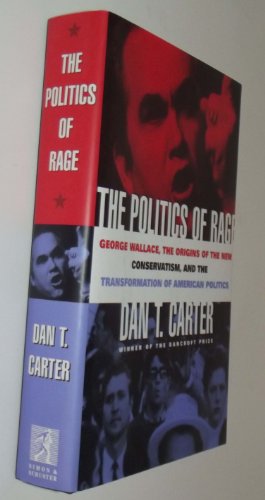
In the first unauthorized study of Wallace in two decades, a professor of history shows how Wallace's segregationist politics launched the anti-Washington populist movement that ultimately swept Republicans to power in 1994. 25,000 first printing.
Reviews
Despite the title, this book is mainly an interpretive biography of former Alabama governor Wallace, with few revelations but more of a skeptical edge than Stephan Lesher's recent authorized bio, George Wallace: American Populist. (This book argues, contra Lesher, that Wallace did in fact vow not to be "out-niggered.") A history professor at Emory University, Carter (Scottsboro) has produced a detailed and readable account of Wallace?"the most influential loser in twentieth-century American politics"?as political animal, driven by ambition far more than by ideology, with a disarmingly folksy personal style. On the wrong side in so many civil rights-era clashes, from Bull Connor's brutality in Birmingham to the admitting of black students to the state university, Wallace nonetheless tapped the "Southernization" of suburban and ethnic white America, thereby fueling his two presidential bids. Though his crippling in a 1972 assassination attempt ended his political career, Wallace, as the author states in a coda, anticipated "the conservative groundswell that transformed American politics in the 1980s."
Copyright 1995 Reed Business Information, Inc.
Though our ever-shortening national attention span seems to convince many Americans that Newt Gingrich or Ronald Reagan invented the "New Conservatism," Emory University historian Carter argues cogently that Alabama governor and four-time presidential candidate Wallace was in fact "the alchemist [who compounded] racial fear, anticommunism, cultural nostalgia, and traditional right-wing economics into a movement that laid the foundation for the conservative counterrevolution." This is at once a perceptive unauthorized biography of George Corley Wallace--based on thorough archival and secondary research and dozens of interviews--and a thoughtful analysis of Wallace's critical role in what writer John Egerton has called "the Americanization of Dixie and the Southernization of America." Readers who still wonder how the "mainstream" shifted so far to the right, how oversimplification, polarization, and "blaming the victim" became so fashionable, and how nationalism, racism, and religious fundamentalism could become litmus tests of political correctness in a secular democracy would do well to read The Politics of Rage. Mary Carroll
Historian Carter's biography of the former Alabama governor and presidential candidate emphasizes Wallace's ability to exploit white racism and social conservatism to further his political career. It contends that he gave voice to themes that were to be used effectively by Republican politicians in their electoral victories of the 1970s, 1980s, and 1990s. Carter concludes that Wallace was the "most influential loser in twentieth century American politics." Another recent biographer, Stephen Lesher (George Wallace: American Populist, LJ 3/1/94), attributes to him an even wider influence?one affecting liberal and conservative politicians of both major parties. Carter's work has the more complete account of Wallace's administrations as governor and of his political campaigns, while Lesher's biography offers more insight into Wallace as a person. Academic libraries should have both volumes. For other collections, either would be an acceptable choice.?Thomas H. Ferrell, Univ. of Southwestern Louisiana, Lafayette
Copyright 1995 Reed Business Information, Inc.
"About this title" may belong to another edition of this title.