Synopsis
"A brilliant effort. . . .For those who would like to study larger issues about communication policy the book would be especially useful."
--Mid Day
"The greatest value of the book lies in presenting an excellent historical perspective; sleek documentation is the sterling merit of the book.... Researchers will find access to this volume extremely rewarding and prodigiously beneficial in their pursuits."
--The Hindustan Times
"The Politics of World Communication, with its underlying concern about human rights, provides a treasure-trove of facts and data on political processes, political actors and decisions that determine the global communication environment. The Politics of World Communication should be quite useful for graduate courses in international communication, comparative telecommunication systems and international relations. The book provides an integrated approach to a wide range of issues spanning international communication, telecommunication technologies, globalisation, human rights, disparity of facilities and resources, freedom of expression, cultural domination, media monopoly, political and non-political actors, etc., in a cohesive manner."
--Yahya R. Kamalipour in Global Society
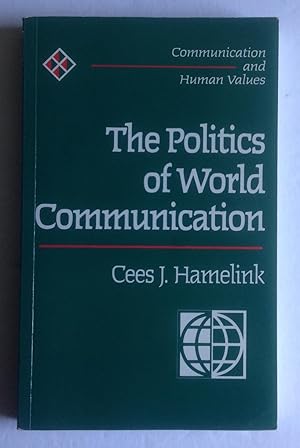
Communication is an arena of world politics in which governments, businesses, and nongovernmental organizations seek to influence the basis of communicative exchange. In The Politics of World Communication, Cees J. Hamelink examines the political processes and decisions that determine the global communication environment. Mass communication, telecommunication, data traffic, intellectual property, and communication technology have all been regulated by agreements within the international community. Examining negotiation processes and their outcomes, the author offers comprehensive analysis of the global politics of communication and its implications for specific nations, areas, and communities. Underlying this analysis is the fundamental concern with communication and human rights. Hamelink examines the standards agreed upon in international communication that address the interests of ordinary people in their everyday lives.
Offering a unique analysis of world communication politics and combining a broad humanitarian perspective, The Politics of World Communication is invaluable to scholars and students of international communication, global politics, international law, and human rights.
About the Author
Dr. Cees J. Hamelink is Emeritus Professor of International Communication at the University of Amsterdam. He is also currently Professor for Information Management at the University of Aruba, and Professor of Human Rights and Public Health at the Vrije Universiteit of Amsterdam.
He is the editor-in-chief of the International Communication Gazette and Honorary President of the International Association for Media and Communication Research (IAMCR). He is author of 17 monographs on communication, culture, and human rights. His latest book is a textbook on Global Communication (SAGE, 2015).
Professor Hamelink received life-time achievements awards from various international organisations and has been consultant to many national governments and agencies in the UN system.
"About this title" may belong to another edition of this title.