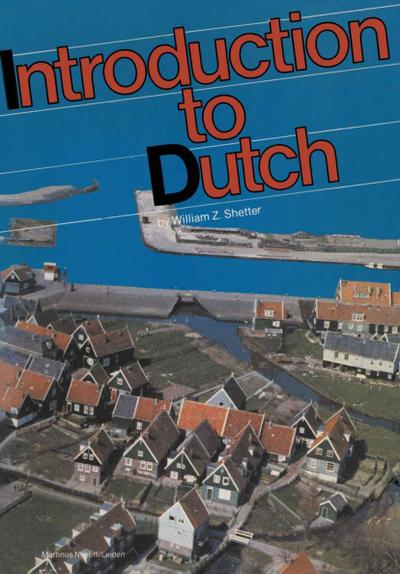
A Practical Grammar Introduction to Dutch
William Z. Shetter
Sold by AHA-BUCH GmbH, Einbeck, Germany
AbeBooks Seller since August 14, 2006
New - Soft cover
Condition: New
Ships from Germany to U.S.A.
Quantity: 1 available
Add to basketSold by AHA-BUCH GmbH, Einbeck, Germany
AbeBooks Seller since August 14, 2006
Condition: New
Quantity: 1 available
Add to basketDruck auf Anfrage Neuware - Printed after ordering - The Dutch language.- 1 Pronunciation.- Front,7bunded, front-rounded vowels.- The vowels.- The diphthongs.- The consonants.- Assimilation.- Stress.- 2 Spelling.- Spelling rules: closed syllable and open syllable.- The relationship of f to v and of s to z in certain words.- The n of the common ending -en.- Making the spelling adjustments.- 3 The plural.- The plural-en.- The plural-s.- Other plurals.- 4 Articles and demonstratives.- The definite article.- The word for this.- The word for that.- The demonstrative adjectives.- The indefinite article.- 5 Personal pronouns; the verb.- The subject forms.- Use of pronouns.- Present tense.- Spelling.- Yes-no-question.- 6 The verb; Hebben and zijn. Imperative.- Verbs with stems ending in -t or -d.- The verbs: gaan, staan, doen, slaan, zien.- The verb: komen.- The verbs: hebben and zijn.- The imperative.- 7 Reading selections. The place of the verb.- Amsterdam.- 8 The adjective. The adverb. Comparison.- Adjective ending in -e.- Adjective without ending.- Een + adjective + noun referring to male.- Linker- and rechter-.- Adverbs.- Comparison of adjectives and adverbs.- The superlative used as an adverb.- Adjectives ending in -s.- 9 Object pronouns. Reflexives.- The object forms of the personal pronouns.- The subject or object pronoun die.- A sentence with two objects: direct and indirect.- The reflexive pronouns.- Use of prepositions.- 10 Possessive adjectives.- The possessive adjectives.- Adjective ending after possessive.- The possessive pronouns.- The van construction.- The z'n/d' r-construction.- 11 Numbers and dates. Currency and measurement.- The numbers.- The ordinal numbers.- Dates.- Units of currency and measures.- 12 Reading selections.- Nederland.- Zuid-Holland.- Voorjaar door Mies Bouhuys.- 13 The past tense('weak' verbs).- The past tense of weak verbs.- The past participle.- The perfect tense.- 14 The past tense ('strong' verbs).- The past tense of strong verbs.- Vowel changes in the stem.- Conjugation with hebten or zijn.- The past participle without ge-.- 15 Some irregular verbs. The past perfect tense.- Some irregular verbs.- The past perfect tense.- Use of tenses.- 16 Modal auxiliaries. Verb plus infinitive.- Modal auxiliaries.- The construction: mogen van, moeten van and niet hoeven van.- Independent use of the modals.- The verb laten.- Other verbs used in association with an infinitive.- 17 The future. The present participle and the infinitive.- The verb zullen.- The verb gaan.- Present-tense form for future.- The present participle.- Progressive aspect.- The infinitive.- 18 Review and reading.- Spoken language versus written language.- 19 Separable prefixes.- Stressed separable prefixes.- Stressed inseparable prefixes.- Inseparable prefixes.- 20 Conjunctions, relative pronouns.- Coordinating conjunctions.- Subordinating conjunctions: word order.- Subordinating conjunctions: meanings.- Relative pronouns.- 21 Word order: the places in the sentence.- Second place in the sentence.- First place in the sentence.- Last place in the sentence.- The negating adverb niet.- 22 The word ER. Prepositional compounds.- er + preposition.- Other functions of er.- 23 Diminutives.- The forms of the diminutives.- Use of the diminutive.- 24 The passive voice.- The passive construction.- Er and the passive sentence.- Active construction with men or je.- 25 Reading selections.- Geschiedenis.- Prinsjesdag.- De Kroon en het Parlement.- Verzuiling.- 26 Telling time.- Hour and half-hour.- Adverbs of time.- 27 Idiomatic usages of some common verbs.- Gaan.- Blijven.- Aan' t.zijnand bezig zijn te.- Liggen, zitten, staan.- Kennen and weten.- Leven and wonen.- Verstaan and begrijpen.- Betekenen and bedoelen.- Onthouden and zich herinneren.- Vallen, opvallen, meevallen and tegenvallen.- Hebben.- 28 Word formation and derivation.- Compounding.- Derivation by suffixes.- Stress shift in derivation.- 29 Three stories.- Het kopje koffie.- Gezichten.- Regenb.
Seller Inventory # 9789024799787
"About this title" may belong to another edition of this title.
General Terms and Conditions and Customer Information / Privacy Policy
I. General Terms and Conditions
§ 1 Basic provisions
(1) The following terms and conditions apply to all contracts that you conclude with us as a provider (AHA-BUCH GmbH) via the Internet platforms AbeBooks and/or ZVAB. Unless otherwise agreed, the inclusion of any of your own terms and conditions used by you will be objected to
(2) A consumer within the meaning of the following regulations is any natural person who concludes...
We ship your order after we received them
for articles on hand latest 24 hours,
for articles with overnight supply latest 48 hours.
In case we need to order an article from our supplier our dispatch time depends on the reception date of the articles, but the articles will be shipped on the same day.
Our goal is to send the ordered articles in the fastest, but also most efficient and secure way to our customers.
| Order quantity | 30 to 40 business days | 7 to 14 business days |
|---|---|---|
| First item | US$ 71.64 | US$ 83.17 |
Delivery times are set by sellers and vary by carrier and location. Orders passing through Customs may face delays and buyers are responsible for any associated duties or fees. Sellers may contact you regarding additional charges to cover any increased costs to ship your items.