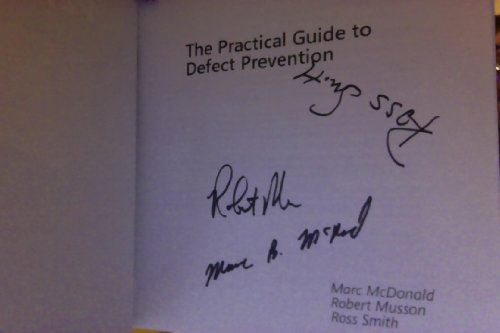
This practical, hands-on guide captures, categorizes, and builds a process of best practices to avoid creating defects during the development process rather than fixing them after extensive analysis. While there are various proprietary and competing standards for reducing software defects, these methods suffer from issues surrounding timeliness, effectiveness, or cost. What s more, many other books focus on fixing errors after they ve been introduced. This guide, however, presents practical methods for reducing defect introduction through prevention and immediate detection and by moving the detection of defects closer to their introduction. Written by experts with over a century of software development experience among them, this book is not an idealized academic book. Instead, it distills many hard-won lessons into a single, workable lifecycle process that will help deliver better quality software.
All authors are Microsoft employees on the Defect Prevention team.
Harry Emil has worked at Microsoft for 15 years as a product support specialist, tester, and developer. He ran a hardware compatibility lab and has worked on the development of numerous intranet and Internet Web properties.
Lori Ada Kilty has spent 16 years in the computer industry and 20 years in the Air Force and the National Guard. She is a Six Sigma black belt and has worked as a program manager, developer, and test manager.
Marc McDonald’s career spans the entire 30-year personal computer industry from its infancy with the MITS Altair to today. He was Microsoft’s first salaried employee, and he designed the FAT file system for MS-DOS®. He holds five software patents. He has worked as a principal research scientist and developer for a number of companies in between stints at Microsoft.
Robert Musson has more than 25 years of software experience as a development engineer and in various management positions. He spent 15 years at Teradyne, helping bring to market a variety of products for the telecommunications industry. While there, he helped deploy the Team Software ProcessSM (TSPSM) to the first industry site. He was vice president of business strategy at a small start-up before becoming a member of the TSP Initiative at the Software Engineering Institute.
Ross Smith has been in the software industry for almost 20 years, developing and testing software on mainframe systems, handheld devices, Windows, and Microsoft Office. He holds five software patents.