Synopsis
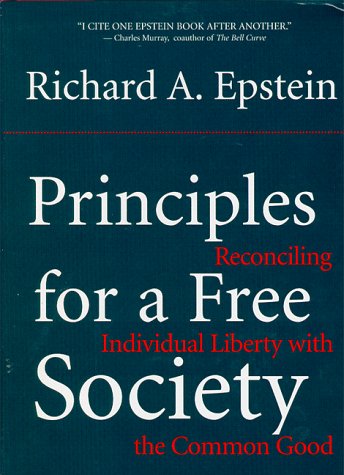
As government budgets come under political fire and free-market ideals spread, the legal and social principles of libertarian thought continue to grow in popularity and relevance. It is particularly timely, then, that Richard Epstein, one of our country's most distinguished legal scholars, here sets out an authoritative set of principles that explains both the uses and the limits of government power. Blending his deep knowledge of classical political theory and legal history with modern economic thought, he considers a wealth of timely topics: the use of norms and customs in setting legal rules; the appropriate spheres for both private and common property for such diverse resources as water and telecommunications; the dark side of altruism in driving collective behavior; and the relative merits of public and private assistance to the poor. Drawing on the work of multiple disciplines, Principles for a Free Society offers a thoroughly realized blueprint to guide us through political conflict in the troubled times ahead.
Reviews
A truism of academe is when faced with a dilemma, make a distinction. Epstein, professor of law at the University of Chicago and author of Mortal Peril: Our Inalienable Right to Health Care?, follows this advice in trying to reconcile individual liberty and the common good. In lucid, readable prose he argues that the two are compatible, provided that certain distinctions and qualifications are made. Epstein spends considerable time explicating the laissez-faire doctrine, insisting that it need not glorify the individual at the expense of society: when applied pragmatically rather than dogmatically, it maximizes the welfare of all. Epstein realizes, of course, that the Achilles heel of the free-market system is the inequitable distribution of wealth, but he believes that a "voluntary redistribution" will solve the problem, although "it will always leave some individuals short." Similarly, he says, it's "always painful to deny recovery for an individual in need" but we don't want a system that encourages self-destructive behavior. At this point one suspects that Epstein's book does not reconcile freedom and equality so much as champion laissez-faire capitalism with some limitations. One also wonders whether he shouldn't care more that Adam Smith's unseen hand can become the unseen foot, kicking those who are down.
Copyright 1998 Reed Business Information, Inc.
A generation of social activists has seen in economic liberty merely a license for greed and aggression. Legal scholar Epstein sees much more: he finds a proven safeguard against state tyranny and an engine of social prosperity. But to defend laissez-faire against its critics, he must demonstrate that individual liberty in the use of private property can foster the common good, while still permitting government action--in regulating monopolies, for instance--when private initiative will not suffice. It is indeed the nuanced concessions that make the overall defense of free enterprise compelling, just as they give strength to the critiques of misapplied state coercion. In sketching out the proper limits for state power, Epstein opens exceptional insights into why society depends on cultural norms and family loyalties that neither courts nor legislatures can replace. The rigorous reasoning buttressed by exhaustive scholarship ensures sustained demand for this book among serious students of legal philosophy. Bryce Christensen
As Epstein, the James Parker Hill Distinguished Service Professor of Law at the University of Chicago, correctly notes in his introduction, laissez-faire economics is one of the most frequently criticized theories ever proposed. But libertarianism, the subject of this book, is much more than laissez-faire economics. When coupled with the absolutism of individual rights and minimalist government, libertarianism produces a social Darwinist society. Epstein attempts to present a balanced explanation of libertarianism while still mightily defending its basic principles. Often criticized as unsympathetic to the common good, libertarianism as described here does have a more human face. Though he makes many questionable assumptions, Epstein should be commended for his clear discussion of the development of libertarianism's basic tenets. The result, while not an easy read, is worth the effort of anyone seeking to understand libertarianism and what it may offer America.?Thomas J. Baldino, Wilkes Univ., Wilkes-Barre, PA
Copyright 1998 Reed Business Information, Inc.
"About this title" may belong to another edition of this title.