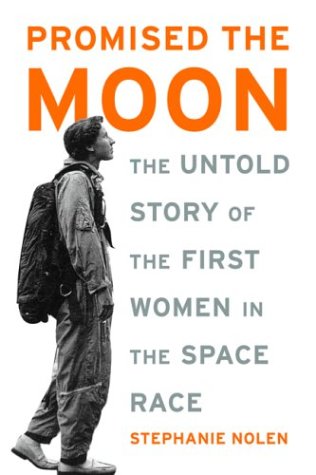
In 1959, the doctor who supervised NASA's astronaut selection concluded that women might fare better in space than men. His testing of 25 top female pilots for reactions to isolation, centrifuge, and weightlessness proved him right, and 13 exceptional candidates were identified. Despite countless personal and professional sacrifices, these women joined NASA's clandestine new program – which, after two intensive years, was suddenly, and mysteriously, canceled. Promised the Moon chronicles the dramatic story of the rise and fall of these pioneering female astronauts, patriots betrayed by men like John Glenn, who opposed women astronauts, and by someone from their own ranks. The first writer to track down the surviving Fellow Lady Astronaut Trainees, Stephanie Nolen vividly brings this fascinating and timely tale to life. Historical photographs are included in this riveting account.
In one of those strange coincidences that often occur in publishing, this is the second book this summer (after Martha Ackmann's The Mercury 13) to relate the little known but remarkable story of the 13 women who trained in the early 1960s to be Mercury astronauts, and though a slightly less satisfying effort, this is still compelling reading. These women passed many of the same grueling tests taken by the male Mercury astronauts, but they were opposed by virtually everyone in power at NASA. In addition to bringing many of the 13 to life, Nolen, a foreign correspondent for Canada's Toronto Globe and Mail, does an excellent job of describing the social context in which they operated. She explains that although institutional sexism and a strong antifemale bias among most players at NASA certainly existed, American society at large was not yet ready to permit women to be placed in the roles for which these women were training. Even many women felt this way, and Nolen explains how Jackie Cochran, one of America's best-known female aviators, spoke forcefully against sending women into space. Cochran's motives, according to Nolen, were complex; she didn't want to antagonize powerful male friends, she didn't want other women to overshadow her achievements and she felt that women weren't physically capable of performing such activities. Although Nolen interviewed 11 of the original 13, her material isn't quite as personal as Ackmann's. Nonetheless, this is impossible to put down and deserves widespread attention. 30 b&w photos.
Copyright 2003 Reed Business Information, Inc.