Synopsis
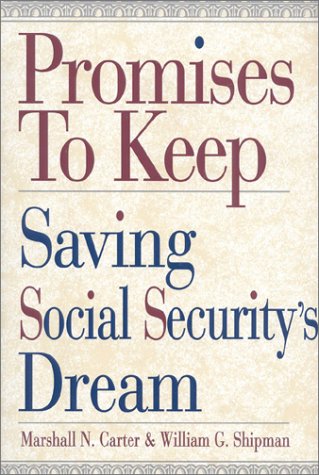
Carter and Shipman - who have spent their careers building retirement investments for individuals, institutions, and nations - show how we can gradually replace the Social Security system while fully guaranteeing full benefits to all Americans. Their solution would allow people the freedom to invest their FICA taxes in financial assets that more than meet retirement needs at a fraction of Social Security's cost.
Under their plan, financial security for all retirees would be more certain, worker's taxes would be cut, and the nation's staggering unfunded Social Security liability would drop by 60 percent. Disability and hospital insurance would continue as they are - neither would be altered even slightly.
Promises to Keep is not a doomsday book. Nor is it a jargon-filled economics text. Rather, it is a book that points to a secure future for all Americans.
Reviews
The Social Security system is edging toward insolvency: by the year 2014 there will be only 2.7 workers for each person receiving benefits, and by 2030 the system's annual cash deficit will be an estimated $700 billion. The authors' plan calls for phasing out the current system by introducing Personal Social Security Accounts (PSSA), which would allow employees to invest a portion of their Social Security taxes in stocks, bonds, certificates of deposit, mutual funds and other instruments?a savings account controlled by individual depositors and earmarked for retirement. No worker now paying into Social Security would be required to leave the system. They claim that the PSSA plan, which has been floated by others as well, would increase U.S. savings, reduce the payroll tax and raise retirement benefits. They cite long-term portfolio growth rates of 10% or more annually, and point to the success of a similar private, self-funded system in Chile. Whether the PSSA is politically viable is debatable, but this manifesto should nevertheless serve to further the national debate. Carter is chairman and CEO of State Street Bank and Trust Company, the largest custodian of pension funds in the U.S.; Shipman is a principal of State Street Global Advisors. 30,000 first printing; author tour.
Copyright 1996 Reed Business Information, Inc.
The U.S. Social Security program will begin to run deficits early in the 21st century and never recover, note the authors. In a presentation geared to general readers, Carter and Shipman, both investment specialists working in the private and public sectors, first detail problems of the current system, primarily that benefits are funded by current workers and that the ratio of workers to beneficiaries is falling. Next, they provide a history of Social Security and similar plans around the world. Finally, the authors explain their plan. Current workers would choose between the current system or one in which benefits are funded by a worker's own contributions. That system would be mandatory for new workers. The authors' analysis is solid, and their plan appears workable, but they dismiss too readily other options, such as allowing current Social Security surpluses to be invested for higher yields. Nevertheless, their book may correct some readers' misperceptions about the system, and it persuasively makes the case for partial or complete privatization. For public and academic libraries.?A.J. Sobczak, formerly with California State Univ., Northridge
Copyright 1996 Reed Business Information, Inc.
"About this title" may belong to another edition of this title.