Synopsis
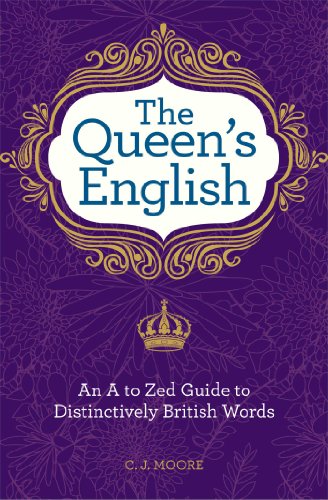
From "chips" and "crumbs" to "spending a penny," "The Queen's English" is your indispensable guide to surviving and thriving in the tricky byways of the English language, which has shown many a poor soul the way out for little more than twanging a vowel, splitting an infinitive or, crime of all crimes, saying dinner instead of tea. With "The Queen's English" there's no need to become "flummoxed" ever again. This must-have A to Z guide uncovers the quintessential meanings behind more than 100 familiar words and phrases of the distinctively British lexicon, including:
By hook or by crook (adv. phrase): It is good to find a phrase in common use that goes back as far as this one, and which appears (though not entirely proven) to link back to England's feudal past. In medieval times when the peasantry were not allowed to cut down trees, they were permitted nonetheless to gather firewood from loose or dead branches which could be obtained using "hook" (bill hook, a traditional cutting tool) or "crook," a staff with a curved end. No doubt the desperate peasant often exceeded the strict use of these tools, and so the sense is to achieve something by whatever means possible. The first recorded use of the phrase is from the fourteenth century. Gazump (vt.): Usually so proud of their reputation for playing fair, the English have a curious blind spot when it comes to buying and selling houses. To "gazump" is to raise the price of a piece of real estate after the sale has been agreed but before the contract is signed, usually on the pretext that the owner has received a higher offer elsewhere. The original buyer is then forced to raise their offer or the property goes to the higher bidder. This unethical but not illegal practice appeared first with the spelling "gazoomph" and was derived from an older and more general term "gazumph" (or gezumph) for the various kinds of swindling that go on at dishonest auctions. In a nutshell (adv. phrase): "Oh God, I could be bounded in a nutshell and count myself a King of infinite space..." cries Hamlet in Shakespeare's tragic play. But the meaning of the expression, namely, to put much into a small space, goes way back to classical times, to Pliny's "Natural History" where he writes: "Cicero records that a parchment copy of Homer's poem "The Iliad" was enclosed in a nutshell ("in nuce")." In Shakespeare's own time, a Bible is said to have been produced that could fit into a nutshell, and that curiosity may have come to the playwright's notice. People like us (np.): Often abbreviated to PLU, this phrase is used by those of a certain social class to approve of others as acceptable by birth and station, and originates in the 1940s milieu typified by the artistic, wayward, and eccentric Mitford sisters, daughters of the second Baron Redesdale. We get a flavor of the attitude where Nancy Mitford, in a letter to her sister Jessica (August 28, 1957), declared that "People Like Us are never killed in earthquakes ...." Nancy refined the art of social class distinctions in her book "Noblesse Oblige" with a list of subtle differences in vocabulary first defined as U (upper class) and non-U (aspriring middle class) by the sociolinguist Alan Ross in 1954.
So if you ever wanted to know what it means to be a "meat-and-potatoes man," a "lame duck," or to be in a "pretty pickle," stop "umming and erring" and read this fascinating collection "straightaway."
About the Author
Linguist Christopher J. Moore is the author of the highly successful In Other Words: A Language Lover's Guide to the Most Intriguing Words around the World. He is an author and editor for both adult and children's books, including a collection of Gaelic poetry. He lives in France and Spain.
"About this title" may belong to another edition of this title.