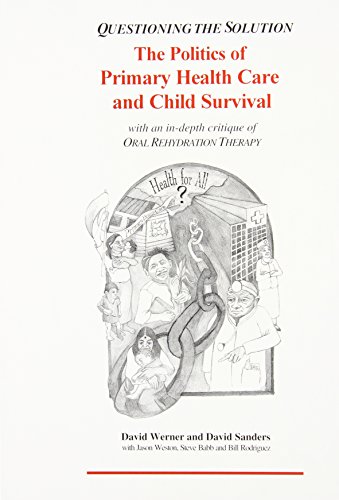
Questioning the solution analyzes why 13 million children
still die every year from preventable causes and challenges
conventional Primary Health Care and Child Survival Strategies. Too
often, health and development planners try to use technological fixes
rather than confront the social and economic inequities that
perpetuate poverty, poor health and high child mortality. As a case
study, the authors show how marketing Oral Rehydration Therapy as a
commercial product, rather than encouraging self-reliance, has turned
this potentially life-saving technology into yet another way of
exploiting and further impoverishing the poor. The book explores the
history of medicine and public health since colonial times and shows
that health is determined more by the equity or inequity of social
structures than by conventional health services. It reveals how
structural adjustment policies and the globalization of the economy
diminish the health and quality of life of vulnerable people,
especially women and children. Examples from African and Latin
American countries illustrate instructive approaches to health and
development that put human needs before top-heavy economic growth.
David Werner, a biologist by training, has spent the last 30
years working to help poor farming families in the mountains of
Western Mexico to protect their health and rights. Project Piaxtla,
the villager-run program to which he has been a facilitator and
advisor since 1965, has contributed to the early conceptualization and
evolution of Primary Health Care. The three main books he has written
and illustrated - "Where There Is No Doctor", Helping Health Workers
Learn" and " Disabled Village Children" - are among the most widely
used in the field of community-based health care and community-based
rehabilitation. He has worked in more than 50 countries - mostly in
the Third World - helping to facilitate workshops and training
programs and as a consultant. David has received several awards for
his groundbreaking work, including the world health organization's
first International Award in Health Education in 1985 and the
MacArthur "genius" fellowship in 1991. He is a founding member of the
International People's Health Council and of HealthWrights (Workgroup
for People's Health and Rights).
David Sanders was born in South Africa and grew up in
Zimbabwe, where he qualified as a medical doctor. During the 1970's,
he lived and worked in Britain where he specialized in paediatrics and
later in Tropical Public Health. While there he was actively involved
in campaigns to defend the National Health Service and in solidarity
work with the liberation struggles in the former Portugese African
Colonies, Zimbabwe and South Africa. He was also a founding member of
ZIMA (Zimbabwe Medical Aid) and the "Politics of Health" group. In
1980 David Sanders returned to the newly independent Zimbabwe as
Coordinator of a rural health program developed by OXFAM in
association with the Zimbabwe Ministry of Health. He also initiated
and helped develop a national children's supplemental feeding program
and actively contributed to the reconstruction and development of
Zimbabwe's health system. He joined the Department of Paediatrics and
Child Health of the Medical School in Harare and later transferred to
the Department of Community Medicine, in which he was a latterly
Associate Professor and Chairperson. During this period, he was
centrally involved in the restructuring of the Medical Undergraduate
curriculum. In 1992 he became director of Staff/Student Development at
the Medical School of the University of Natal in South Africa, where
he became actively involved in health policy development with the
African national Congress (ANC) and SAHSSO (South African Health and
Social Services Organization). In 1993 he was appointed as Professor
and Director of a new Public Health program at the University of the
Western Cape, Cape Town, South Africa, which provides practice
oriented education and training in public health and primary health
care to a wide range of health and development workers. He is the
author of the book, "The Struggle for Health: Medicine and the
Politics of Underdevelopment", as well as several booklets and
articles on the political economy of health, structural adjustment,
child nutrition and health personnel education.