About this Item
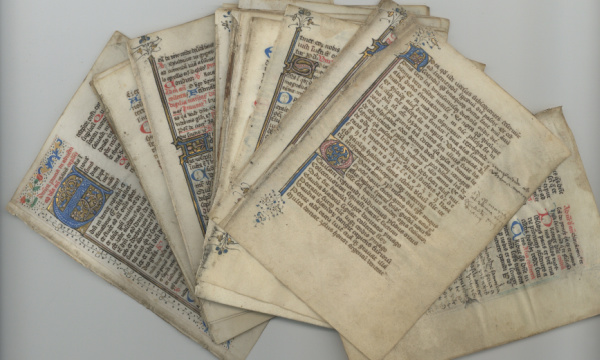
Records show only a small number of such mathematical devices having reached the public market?The manuscript bears markings of subsequent owners, including a poem from the 16th century to Saint Basil, normally associated with the East[video width="1920" height="1080" mp4="https://cdn.raabcollection.com/wp-content/uploads/20231204130536/Computus-Youtube-Template-1.mp4"][/video]?Prior to 1420, devotional books such as Books of Hours or Breviaries were made to order and reflected the particular interests of the patron. A breviary, usually formatted in a writing block of two columns (as opposed to its single column relative, the Book of Hours), contains excerpts of psalm, gospel, hymns, and prayers, to guide the reader in his or her daily prayer at the fixed Canonical Hours. Because these books were created at this time for a specific use, they could be catered to that use, including the use of alternate texts. This would also be the case for clergymen.One of the most important branches of medieval learning was computus, the science of calculating times and dates using a combination of mathematics and astronomy. The use of poetry to transmit scientific material would have made it easier for students to memorize. These calculations were often applied to the tricky and at times controversial calculation of the date of Easter, a highly variable and occasionally contentious date relying on lunar calendars, the date of the Jewish celebration of Passover, and whether or not the observer is on the Julian or Gregorian calendar. Easter remains celebrated on different days in the West than the East.In 1408, a Yorkshire man named John de Foxton (ca. 1369-1450) wrote an encyclopaedic work called Liber Cosmographiae, now housed at Cambridge, Trinity College, MS. R.15.21. John?s extensive work includes a poem on fol. 19v. The poem includes the line ?Qu[a]erit amor Christi multos dum regnat iniqus? (The love of Christ seeks many, while the unjust reign). It appears in a very limited number of other manuscripts. It is a cipher. The poem also includes seemingly unrelated letters, written in red, above each of the words. These letters would accompany the poetic text, making the poem into a memory-based (mnemonic) device to figure out the date of Easter (John de Foxton?s Liber Cosmographiae: An Edition and Codicological Study, 1988, p. xxiii-xxiv).Such computational texts, which can combine a description of the calculation process, along with the paired poetic text / letters, are occasionally found in texts of this period but finding them on the market would be very uncommon.Within the first decade of the fifteenth century, an ecclesiastical man, a member of the clergy, had a breviary commissioned for him.[Breviary, in Latin, ca. 1410, Flanders or Luxembourg] 2-, 3-, and 4- line initials in blue and pink with white penwork, shellgold illumination; 23 partial borders consisting of a pink and blue bar extending the length of the text, illuminated with gold and often terminating in penwork floral sprays.Within this book, which he would use for his daily prayers, he had an unusual selection incorporated ? a paraphrase of a computus text, along with the Foxton poetic mnemonic, computistical text to further solidify his study and understanding of the dating of Easter. The letters of the Foxton text were added, though in a slightly different structure.Combined, these instructions describe the dating of easter and include an alphabet written out to help the ciphering. The text also mentions a Charles (Karolus) who says [or teaches] on the matter in ?m cccc lvxxiii? The year, 1478, is a scribal error, inserting an extra century, for what should have been m ccc lvxxiii. On November 29, 1378, Charles of Luxembourg, better known as the Holy Roman Emperor died. This portion of text of the ecclesiastic?s breviary is a paraphrase and therefore not published as is in any source we could determine.A curious manuscript likely refering to the computistical ideas of C.
Seller Inventory # 26261
Contact seller
Report this item