Synopsis
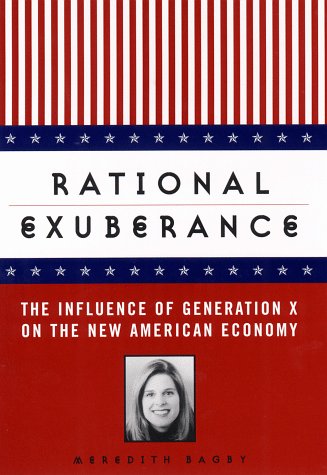
A young reporter for CNN's Financial News Network analyzes the economic habits of people in their twenties and thirties, their influence on the national economy, and the challenges they face in an era of diminishing expectations.
Reviews
Where does Bagby, a law student and regular reporter on Gen-X issues for CNN's Financial News Network, fit in the deluge of printed matter about Americans born between 1964 and 1976? Unlike many of her cohorts who focus on "cultural" aspects of the crowd, Bagby defines the Gen-X era as "The Age of Economics." Despite higher levels of education and employment, she reports, Gen-Xers are making relatively less than their parents did, contending with a shrinking social safety net and accruing more debt?all of which makes monetary matters their main preoccupation (rather than, say, the idealism of the boomers in their heyday). Having thus defined members of Generation X as fiscal creatures, Bagby next tries to defend them with profiles of successful, rationally exuberant members of their ilk: fitness executives, publishers, pollsters and bankers. She cites savings rates, successful start-ups and business school retreads as examples of how most Gen-Xers are not the lazy, aimless underachievers older generations make them out to be. But Bagby's central thesis that Generation X is defined by economics remains murky when viewed through a more historical lens. Haven't all generations been more or less defined by the economics of their time? Bagby (The Annual Report of the United States of America) is strongest when she sticks to real-life stories of Gen-Xers, and often makes a compelling advocate for their interests.
Copyright 1998 Reed Business Information, Inc.
Bagby, a law student and economist who appears regularly on CNNs Financial News Network, vigorously defends her generation. In her view, putdowns such as the ``slacker'' label commonly aimed at Generation X are media stereotypes created to characterize a phenomenon older generations don't understand. The world has changed and today's youth and young adults are responding to different imperatives and therefore have a different outlook than their parents. Unfortunately, in addition to an overview of the utterly predictable ways in which Generation X will increasingly come to dominate American societytime will march onher book reinforces these stereotypes as much as it dispels them. Consider: Bagby sees her cohort group as diverse, complex, and not easy to pigeonhole, yet in embracing the language of ``us'' and ``we,'' she paints her generation in more monolithic terms than any critic. Continually harping on the problems they face ends up looking preposterous, as if, for example, not having an event like the Vietnam War to shape group identity is a disadvantage. Believing they have gone beyond ideology to look for what ``works'' without noticing that the ``end of ideology'' was declared by some scholars as as far back as the '60s suggests a group identification based as much on failing to learn from the past as on new realities. Contrasting individual success stories with evidence of her cohort group's amazing political apathy in the face of policies diametrically opposed to their short- and long-term interests inspires Bagby to draw positive conclusions about her generation, displaying a contorted logic in which anecdotal evidence is given more weight than general behavior. Gen-Xers will mo doubt like this book and shake their heads at the ignorance of critics who find it simply self-indulgent. -- Copyright ©1998, Kirkus Associates, LP. All rights reserved.
"About this title" may belong to another edition of this title.