Thesmallrefractingtelescopewithitssimpledirectdesignandconstructionand permanently aligned optics is the time tested standard for personal use. Easily portable, it can be taken out of the house and set up at a moment’s notice. Or, it can be packed conveniently into a small car for traveling to a dark observing site. With moderate care and minimal maintenance, the telescope and mount canlastforgenerations. These instruments provide sharp, crisp high-contrast images of the Moon and planets. They are less susceptible to the effects of unstable air than larger ones, and because of their low maintenance and durability they are ideal for the parent educator or lifelong learner. Until recently, however, the high cost ofsmalltelescopesofsufficientqualityforseriousastronomicalusehaslimited theiraccessibility. During the past decade, innovations in optical design and manufacture have loweredcostandimprovedquality.Currentdevelopmentsinlensdesignmakeit possibletoproduceaffordablerefractingtelescopeswithshortertubelengthsand greater versatility. The once very costly 90-mm Maksutov–Cassegrain, with its optimumcombinationofeffectiveopticsandportability,nowsellsforamodest price. I have often seen small instruments referred to as “grab and go” or “quick look,”notworthyofconsiderationforseriousobserving.Imaintaintheycanbe much more. Despite their limits in types of observation, 80-mm refractors and 90-mm Maksutovs have sufficient aperture and magnifying power to provide a lifetimeofobservingpleasure.Theyareidealforlunaroccultationmeasurements, tracking the solar activity cycle, observing variable stars and measuring binary ix x Preface stars. Although all the activities described here are equally applicable to larger instruments,noneofthemrequireanaperturelargerthan80mm.Through the use of common digital cameras, the limiting stellar magnitude andimagescaleofsmalltelescopescanbeincreaseddramatically,thusproviding resultsonenormallyexpectsfromlargerinstruments.Muchofthisbookapplies thatprincipletomakinginterestingandusefulastronomicalobservations.Ihave takennovelapproachestoextendingtheuseofsmallinstrumentsforquantitative observations by applying unique methods for the analysis of digital camera photographs.
It’s often said that astronomy is one of the very few sciences in which amateurs can make a contribution to real science. Even modest telescopes such as a small – 3-inch (80mm) – astronomical refractor or Maksutov can provide scientifically useful data.
This is certainly true, but where to start?
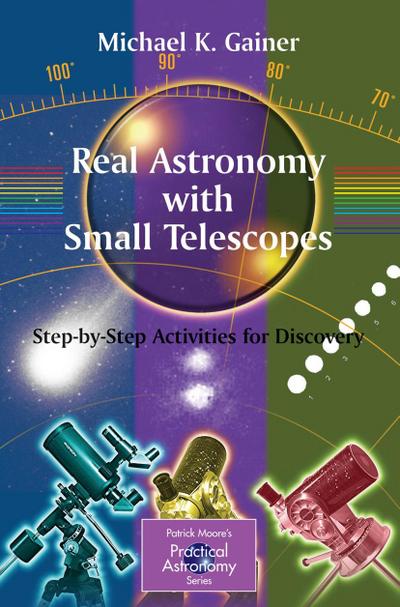
Real Astronomy with Small Telescopes tells you everything you’ll need to know about how to get started on "real" astronomy using a small telescope (and ideally a digital camera), and make a real contribution to our scientific knowledge. This book is the necessary introduction to real astronomy – derived from the author’s many years of experience in teaching the subject – that can be your starting point for serious work. Here, the emphasis is on what you can do with a small telescope, rather than just on what you can see through it.
Finally, owners of big telescopes shouldn’t be put off – everything in this book applies equally (maybe more equally!) to larger instruments.