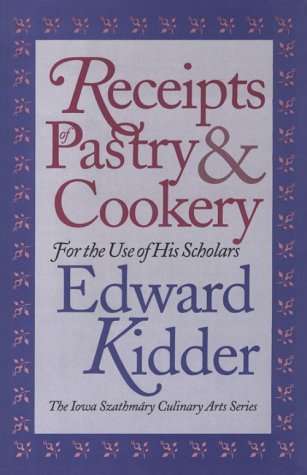
Synopsis
The entrepreneurial Kidder probably dictated this book with his students in mind; surely they would already know how to prepare meats from veal to venison for baking and how hot to make the fire. The notebook contains many recipes for meat "pyes" and pasties with meat, plus recipes for puddings and cakes and meat, poultry, and fish main dishes: First Dishes, Bottome Dishes, Side Dishes, For Ye Midle, Second Course, and Plates. Many recipes have surprising starting points, such as Pidgeon Peares:
Bone your pidgeons all but one leg & put that thro' ye side out at ye vent cut off ye toes & fill them with forcd meat made of ye hart & liver & cover them with a tender forcd meat being washd over with ye batter of egges & shape them like peares then wash them over & roul them in scalded chopt spinnage...
and then a Regalia of Cowcumbers, a Swan Pye, and a Calves head hasht. These recipes predate modern squeamishness about cooking with organ meats and consuming animal fat and display a sense of familiarity with and awareness of flesh that are no longer second nature to cooks. From the perspective of the twentieth century the language seems oddly direct, "take ye flesh of a foul beef suet & marrow ye same quantity," and personalized, as in "toss up a handfull of chopt capers."
Everyone wishing to delve deeper into culinary history will find these recipes, the latest addition to the Iowa Szathmary Culinary Arts Series, fascinating as artifacts of culture and society.
Reviews
As the latest volume in Iowa's maverick and distinguished Szathmary Culinary Arts Series, this one brings us a notebook of the London pastry cook and pioneering cooking teacher Kidder (1665?-1739), with recipes presented in handwritten facsimile and in a typeset transcription. Probably dictated, the recipes are brief, will strike most modern readers as brightly idiosyncratic and are utterly free of gastronomic political correctness: Kidder liked his suet. They make ideal bedside reading. There is, for instance, the one for "A Regalia of Cowcumbers." Dried, fried, gravied, and mixed into a sauce to accompany meat, they are dealt with by Kidder with such dispatch and such quaint spellings that the recipe is like a bluntly physical poem, rough and uneven in its hurl. There are pies (artichoke, egg, pigeon, tongue, calve's head); cakes; puddings (e.g., "a quaking Pudding"); soups; meat dishes ("Bombarded veal"); fish. A glossary is absolutely necessary, and provided. Instructions will not fail to amuse: "Take a good buttock of beef," suggests the master, and "Take a live carp and scale and slice him." Thank God, we can't--not as he did. Schoonover is a curator at the University of Iowa Libraries and an editor of previous Szathmary series titles.
Copyright 1993 Reed Business Information, Inc.
"About this title" may belong to another edition of this title.