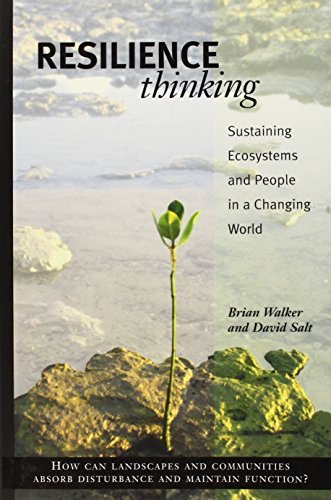
Increasingly, cracks are appearing in the capacity of communities, ecosystems, and landscapes to provide the goods and services that sustain our planet's well-being. The response from most quarters has been for "more of the same" that created the situation in the first place: more control, more intensification, and greater efficiency.
"Resilience thinking" offers a different way of understanding the world and a new approach to managing resources. It embraces human and natural systems as complex entities continually adapting through cycles of change, and seeks to understand the qualities of a system that must be maintained or enhanced in order to achieve sustainability. It explains why greater efficiency by itself cannot solve resource problems and offers a constructive alternative that opens up options rather than closing them down.
In Resilience Thinking, scientist Brian Walker and science writer David Salt present an accessible introduction to the emerging paradigm of resilience. The book arose out of appeals from colleagues in science and industry for a plainly written account of what resilience is all about and how a resilience approach differs from current practices. Rather than complicated theory, the book offers a conceptual overview along with five case studies of resilience thinking in the real world. It is an engaging and important work for anyone interested in managing risk in a complex world.
Brian Walker has been one of the leading proponents of resilience theory and practice in the past two decades. He is currently an honorary fellow at Commonwealth Scientific and Industrial Research Organisation (CSIRO), Australian National University visiting professor, and a fellow in the International Beijer Institute for Ecological Economics in Sweden. Walker was chief of Australia's CSIRO Wildlife and Ecology (1985–1999), chaired the Global Change and Terrestrial Ecosystems Project of the International Geosphere-Biosphere Program (1990–1997), and was director of the international Resilience Alliance (2000–2010). He is a fellow of the Australian Academy of Science and of the Australian Academy of Technological Sciences and Engineering and a foreign member of the Royal Swedish Academy of Agriculture and Forestry. He has a long list of scientific publications and has served on the editorial boards of five international journals. With David Salt, Walker coauthored
Resilience Thinking (Washington, DC: Island Press, 2006) and
Resilience Practice (Washington, DC: Island Press, 2012).
David Salt has been writing about science, scientists, and the environment for much of the last three decades. He created and then produced
The Helix (Australia’s best-loved science magazine for young people) for more than a decade, served as communications manager for the Commonwealth Scientific and Industrial Research Organisation (CSIRO) Division of Wildlife and Ecology, and was the inaugural editor of an Australian version of the popular science magazine
Newton. More recently, Salt has written and edited books on farm forestry and agri-environment policy. He currently edits two research magazines,
Decision Point and
Science for Saving Species, and is based in Canberra at the Centre of Excellence for Environmental Decisions at the Australian National University. With Brian Walker, Salt coauthored
Resilience Thinking (Washington, DC: Island Press, 2006) and
Resilience Practice (Washington, DC: Island Press, 2012).
Walter V. Reid is a consulting professor with the Stanford Institute for the Environment in Stanford, California, and was the Director of the Millennuim Ecosystem Assessment.