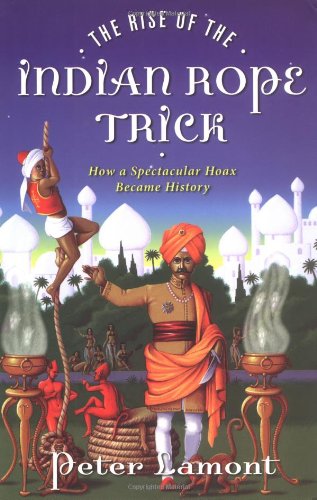
A rope rises up into the air. A boy climbs up the rope and when the boy gets to the top he vanishes into thin air, explains Peter Lamont, winner of the Jeremy Dalziel prize in British History, and author of The Rise of the Indian Rope Trick, about a tall tale that found its way into legend. The rope trick is one of the most successful hoaxes of all time, created by an amateur magician and printed in the Chicago Tribune in 1890. Despite a later admission that the story was false, it continued to spread in newspapers and journals throughout the world. Some claimed to have seen the trick performed on trips to India. Others added their own spin to the tale. Using the original legend as a starting point, Lamont, who has performed as a magician and psychic, explores how easily people will believe stories that are fed to them as truth despite all logical senses and their outright impossibility.
Adult/High School–A performer pulls out a long rope and, with arcane words and gestures, coaxes it to climb high into the sky without any sign of support. The magician then calls on his young assistant, who climbs the rope until he vanishes from view. When the boy doesn't return, the magician angrily follows after him and carries him down to resounding audience applause. Impossible? Yes. Lamont's fun, informative book details the history of this myth and why so many people wanted to believe in it so deeply. The first "hard" reference came from an eyewitness report in the Chicago Tribune in 1890. Although the journalist printed a retraction a few months later, the fabrication had already captured the attention of U.S. and British readers to the extent that others claimed to have witnessed the trick themselves. Strange and frightening stories developed around the swamis and magi who supposedly performed it and the dangers experienced by those who attempted to discover its secrets. Amid the campy facts, Lamont develops interesting conclusions. The late 1800s brought a rise in science and a growing disbelief in the spiritual side of life, and the tale fulfilled a need within educated Westerners to believe in something that couldn't be explained. The faraway land of India as its origin added a level of mystique. In the end, the author shows that the stories we create about other cultures reveal volumes about ourselves.–Matthew L. Moffett, Northern Virginia Community College, Annandale
Copyright © Reed Business Information, a division of Reed Elsevier Inc. All rights reserved.
British historian and magician Lamont relays the strange history of the so-called Indian rope trick. According to legend, a boy clambers up a rope and disappears, followed by a knife-armed fakir, who also vanishes. Severed limbs then tumble from the heavens and reassemble into the living boy. Sound plausible? A group in 1930s Britain was skeptical, and Lamont has a lot of fun describing their inconclusive debunking campaign. Such entertaining insouciance permeates his writing, but Lamont structures his tale seriously and treats the trick as an example of the West's flawed perceptions of the East. Delving into Victorian history, Lamont discusses popular fascination with the East's "mysteries" and presents a gallery of eccentric performers who met the public's demand to be gulled by supernatural feats. Feeding this social appetite was an 1890 Chicago newspaper revelation of the rope trick, which, despite its editor's admission that the article was fabricated, only succeeded in perpetuating the myth. The various tangents related to the Indian rope trick are cleverly united in Lamont's amusing read. Gilbert Taylor
Copyright © American Library Association. All rights reserved