About this Item
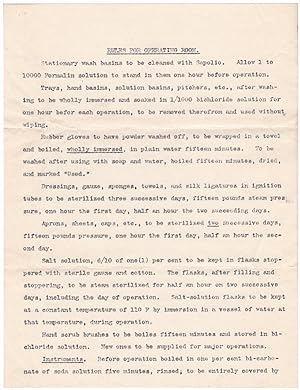
[Np, c.1930s?]. 2pp. Carbon copy typed manuscript. 10¼ x 8 inches. Two folios, cream-colored bond paper. Very good. Antiseptic surgical methods were first popularized after the publication of Dr. Joseph Lister s paper, Antiseptic Principle of the Practice of Surgery (1867). By the 1930s, the boiling and chemical sterilization of surgical instruments, dressings, etc. was standard. According to Rules for Operating Room, everything in the operating room was sterilized: "Stationary wash basins to be cleaned with Sapolio [commercial soap product]. Allow 1 to 10000 Formalin [formaldehyde] solution to stand in them one hour before operation. Trays, hand basins, solution basins, pitchers, etc., after washing to be wholly immersed and soaked in 1/1000 bichloride solution for one hour befor[e] each operation, to be removed therefrom and used without wiping." The sterilization process involved repetition and was sometimes carried out over successive days: "Rubber gloves to have powder washed off, to be wrapped in a towel and boiled, wholly immersed, in plain water fifteen minutes. To be washed after using with soap and water, boiled fifteen minutes, dried, and marked "Used." Dressings, gauze, sponges, towels, and silk ligatures in ignition tubes to be sterilized three successive days, fifteen pounds steam pressure, one hour the first day, half an hour the two succeeding days." Notice two things here: first, the use of steam and second, the instruction to label equipment. In the later instance, that sanitized gloves are to be marked "Used," suggests sterilization was systematic and becoming a specialized task. Later instructions also refer to storage of hypodermic needles and laparotomy sponges. The instruction to use of steam at a specific pressure may help date Rules for Operating Room to the 1930s, when commercial steam sterilizers were first sold in the United States. Other rules cover surgical instruments and the preparation of salt solution for use during surgery. The latter instructions are quite detailed: "Salt solution 6/10 of one (1) per cent to be kept in flasks stoppered with sterile gauze and cotton. The flasks, after filling and stoppering, to be steam sterilized for half an hour on two successive days, including the day of the operation. Salt-solution flasks to be kept at a constant temperature of 110 F by immersion in a vessel of water at that temperature, during operation." Curiously, this salt solution was kept a little higher than body temperature. Surgical sterilization procedures have come a long way since Dr. Lister (after whom Listerine mouthwash is named) and since the 1930s. Rules for Operating Room provides a glimpse into evolving medical changes and the systematic organization of surgical operating rooms and personnel. Ref. Tilton and Kauffman, "Sterilization, A Review of the Basics" in Managing Infection Control (June 2004).
Seller Inventory # 3725628
Contact seller
Report this item