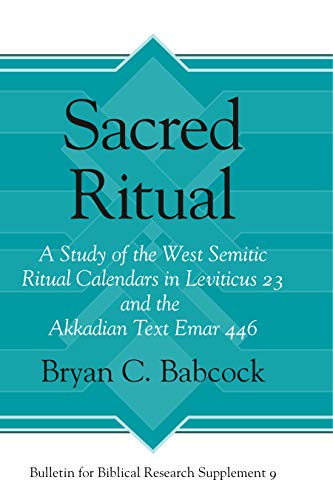
Sacred Ritual (Hardcover)
Bryan C. Babcok
Sold by Grand Eagle Retail, Bensenville, IL, U.S.A.
AbeBooks Seller since October 12, 2005
New - Hardcover
Condition: New
Ships within U.S.A.
Quantity: 1 available
Add to basketSold by Grand Eagle Retail, Bensenville, IL, U.S.A.
AbeBooks Seller since October 12, 2005
Condition: New
Quantity: 1 available
Add to basketHardcover. Israelite festival calendar texts (Exod 23; 34; Lev 23; Num 2829; Deut 16; and Ezek 45) share many features; however, there are also differences. Some of the most-often-cited differences are the following: festival dates, festival locations, date of the New Year, festival timing, and festival names. Scholars have explored these distinctions, and many have concluded that different sources (authors/redactors) wrote the various calendars at different times in Israelite history. Scholars use these dissimilarities to argue that Lev 23 was written in the exilic or postexilic era. Babcock offers a new translation and analysis of a second-millennium B.C. multimonth ritual calendar text from Emar (Emar 446) to challenge the late dating of Lev 23. Babcock argues that Lev 23 preserves an early (2nd-millennium) West Semitic ritual tradition.Building on the recent work of Klingbeil and Sparks, this book presents a new comparative methodology for exploring potential textual relationships. Babcock investigates the attributes of sacred ritual through the lens of sacred time, sacred space and movement, sacred objects, ritual participants, and ritual sound. The author begins with a study of ancient Near Eastern festival texts from the 3rd millennium through the 1st millennium. This analysis focuses on festival cycles, common festival attributes, and the role of time and space in ritual. Babcock then moves on to an intertextual study of biblical festival texts before completing a thorough investigation of both Lev 23 and Emar 446. The result is a compelling argument that Lev 23 preserves an early West Semitic festival tradition and does not date to the exilic erarefuting the scholarly consensus.This illuminating reading stands as a model for future research in the field of ritual and comparative textual studies. "A comparison of the texts regarding ritual in the Old Testament Leviticus 23 and those found in a text from the Syrian site of Emar."-- Provided by the publisher. Shipping may be from multiple locations in the US or from the UK, depending on stock availability.
Seller Inventory # 9781575068268
Israelite festival calendar texts (Exod 23; 34; Lev 23; Num 28–29; Deut 16; and Ezek 45) share many features; however, there are also differences. Some of the most-often-cited differences are the following: festival dates, festival locations, date of the New Year, festival timing, and festival names. Scholars have explored these distinctions, and many have concluded that different sources (authors/redactors) wrote the various calendars at different times in Israelite history. Scholars use these dissimilarities to argue that Lev 23 was written in the exilic or postexilic era. Babcock offers a new translation and analysis of a second-millennium B.C. multimonth ritual calendar text from Emar (Emar 446) to challenge the late dating of Lev 23. Babcock argues that Lev 23 preserves an early (2nd-millennium) West Semitic ritual tradition.
Building on the recent work of Klingbeil and Sparks, this book presents a new comparative methodology for exploring potential textual relationships. Babcock investigates the attributes of sacred ritual through the lens of sacred time, sacred space and movement, sacred objects, ritual participants, and ritual sound. The author begins with a study of ancient Near Eastern festival texts from the 3rd millennium through the 1st millennium. This analysis focuses on festival cycles, common festival attributes, and the role of time and space in ritual. Babcock then moves on to an intertextual study of biblical festival texts before completing a thorough investigation of both Lev 23 and Emar 446. The result is a compelling argument that Lev 23 preserves an early West Semitic festival tradition and does not date to the exilic era―refuting the scholarly consensus.
This illuminating reading stands as a model for future research in the field of ritual and comparative textual studies.
"About this title" may belong to another edition of this title.
We guarantee the condition of every book as it¿s described on the Abebooks web sites. If you¿ve changed
your mind about a book that you¿ve ordered, please use the Ask bookseller a question link to contact us
and we¿ll respond within 2 business days.
Books ship from California and Michigan.
Orders usually ship within 2 business days. All books within the US ship free of charge. Delivery is 4-14 business days anywhere in the United States.
Books ship from California and Michigan.
If your book order is heavy or oversized, we may contact you to let you know extra shipping is required.
| Order quantity | 6 to 16 business days | 6 to 14 business days |
|---|---|---|
| First item | US$ 0.00 | US$ 0.00 |
Delivery times are set by sellers and vary by carrier and location. Orders passing through Customs may face delays and buyers are responsible for any associated duties or fees. Sellers may contact you regarding additional charges to cover any increased costs to ship your items.