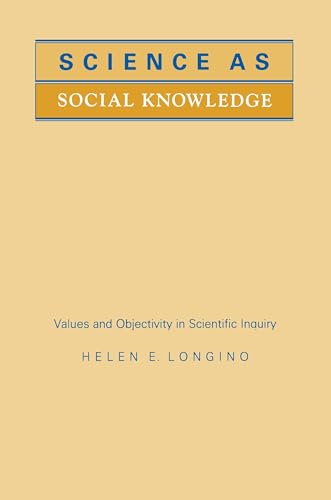
Science as Social Knowledge (Paperback)
Helen E. Longino
Sold by CitiRetail, Stevenage, United Kingdom
AbeBooks Seller since June 29, 2022
New - Soft cover
Condition: New
Ships from United Kingdom to U.S.A.
Quantity: 1 available
Add to basketSold by CitiRetail, Stevenage, United Kingdom
AbeBooks Seller since June 29, 2022
Condition: New
Quantity: 1 available
Add to basketPaperback. Conventional wisdom has it that the sciences, properly pursued, constitute a pure, value-free method of obtaining knowledge about the natural world. In light of the social and normative dimensions of many scientific debates, Helen Longino finds that general accounts of scientific methodology cannot support this common belief. Focusing on the notion of evidence, the author argues that a methodology powerful enough to account for theories of any scope and depth is incapable of ruling out the influence of social and cultural values in the very structuring of knowledge. The objectivity of scientific inquiry can nevertheless be maintained, she proposes, by understanding scientific inquiry as a social rather than an individual process. Seeking to open a dialogue between methodologists and social critics of the sciences, Longino develops this concept of "contextual empiricism" in an analysis of research programs that have drawn criticism from feminists.Examining theories of human evolution and of prenatal hormonal determination of "gender-role" behavior, of sex differences in cognition, and of sexual orientation, the author shows how assumptions laden with social values affect the description, presentation, and interpretation of data.In particular, Longino argues that research on the hormonal basis of "sex-differentiated behavior" involves assumptions not only about gender relations but also about human action and agency. She concludes with a discussion of the relation between science, values, and ideology, based on the work of Habermas, Foucault, Keller, and Haraway. Examining theories of human evolution and of prenatal hormonal determination of "gender-role" behavior, of sex differences in cognition, and of sexual orientation, the author shows how assumptions laden with social values affect the description, presentation, and interpretation of data. Shipping may be from our UK warehouse or from our Australian or US warehouses, depending on stock availability.
Seller Inventory # 9780691020518
Conventional wisdom has it that the sciences, properly pursued, constitute a pure, value-free method of obtaining knowledge about the natural world. In light of the social and normative dimensions of many scientific debates, Helen Longino finds that general accounts of scientific methodology cannot support this common belief. Focusing on the notion of evidence, the author argues that a methodology powerful enough to account for theories of any scope and depth is incapable of ruling out the influence of social and cultural values in the very structuring of knowledge. The objectivity of scientific inquiry can nevertheless be maintained, she proposes, by understanding scientific inquiry as a social rather than an individual process. Seeking to open a dialogue between methodologists and social critics of the sciences, Longino develops this concept of "contextual empiricism" in an analysis of research programs that have drawn criticism from feminists. Examining theories of human evolution and of prenatal hormonal determination of "gender-role" behavior, of sex differences in cognition, and of sexual orientation, the author shows how assumptions laden with social values affect the description, presentation, and interpretation of data. In particular, Longino argues that research on the hormonal basis of "sex-differentiated behavior" involves assumptions not only about gender relations but also about human action and agency. She concludes with a discussion of the relation between science, values, and ideology, based on the work of Habermas, Foucault, Keller, and Haraway.
"Helen Longino has written a timely book that fills a critical gap in the existing literature between philosophy of science and the social studies of science. Her exposition of scientific inquiry as a context-laden process provides the conceptual tools we need to understand how social expectations shape the development of science while at the same time recognizing the dependence of scientific inquiry on its interactions with natural phenomena. This is an important book precisely because there is none other quite like it."--Evelyn Fox Keller, author of Reflections on Gender and Science
"About this title" may belong to another edition of this title.
Orders can be returned within 30 days of receipt.
Please note that titles are dispatched from our US, Canadian or Australian warehouses. Delivery times specified in shipping terms. Orders ship within 2 business days. Delivery to your door then takes 7-14 days.
| Order quantity | 7 to 60 business days | 7 to 14 business days |
|---|---|---|
| First item | US$ 49.36 | US$ 49.36 |
Delivery times are set by sellers and vary by carrier and location. Orders passing through Customs may face delays and buyers are responsible for any associated duties or fees. Sellers may contact you regarding additional charges to cover any increased costs to ship your items.