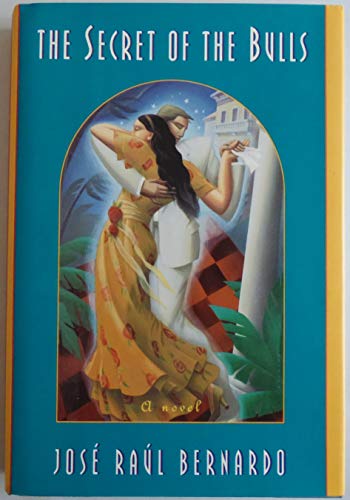
Synopsis
A lively love story in pre-revolutionary Cuba follows the life of butcher Maximiliano, whose world is changed forever when the beautiful Delores falls in love with him and leaves home to marry without permission. 50,000 first printing. Tour.
Reviews
Steamy sex scenes, lush prose, genial spirits and exotic locale (Cuba, mostly Havana, between 1911 and 1938) lend commercial appeal to this unabashedly sentimental first novel. Yet, although it seems to aspire to the earthy comedy and sophistication of Laura Esquivel's Like Water for Chocolate, the writing here is pat and predictable. When Dolores, a wealthy landowner's daughter, elopes at 18 with the butcher Maximiliano, her family disowns her. She finds happiness with her errant husband, however, excusing his constant philandering because he's "an aging champion bull who's just afraid of getting old, so he has to prove to himself all the time that he is still a champion." This taurine imagery pervades the story, in which women are likened to "female bulls," deadlier than the male once provoked. Nevertheless, Merced, daughter of Dolores and Maximiliano (and a Taurus, naturally), can't keep the reins on her husband, who discovers his homosexual nature in a bordello and later commits suicide. Meanwhile, one of Merced's brothers is beset by baseless doubts about his parentage, and another, learning that his wife is unfaithful, refuses to kill the cheating duo, as custom dictates. Bernardo-born in Havana, now living in New York-drenches his present-tense narrative in the lilting rhythms of a more mellow, pre-Communist Cuba. Author tour; simultaneous Spanish hardcover edition from S&S Libros en Espanol.
Copyright 1996 Reed Business Information, Inc.
Earthy, overheated first novel, on the theme of Latin American machismo and its discontents, by a Cuban-born author whom we're invited to compare with Laura Esquivel. Similar popular success may indeed greet this florid family chronicle, set in Cuba and covering the years 191138 in the lives of the lusty butcher Maximiliano, his gorgeous and devoted wife Dolores, and their four surviving children. When the couple first meet, fall thunderously in love, and marry (defying Dolores's wealthy landowning father), the poverty they endure early on forces them to surrender their eldest son Mani to live out his formative years with his grandparents, leaving him thereafter burdened by his sense of himself as ``a child nobody every really wanted.'' Their other children suffer as well: daughter Merced with a troubled young husband whose inability to love her disastrously erodes his own self-worth; and second son Gustavo, a would-be poet whose courage in defying his father's expectations fails when Gustavo cannot--as their macho code demands--murder his faithless wife and her lover. ``The secret of the bulls'' that rush through Havana's streets flaunting their rough masculinity is that their momentum is carrying them toward the slaughterhouse. If this novel has an animating idea, so to speak, that would be it. Bernardo conveys such deeply uninteresting truisms in a bland style that's crammed with sentimental clich‚s and flattened by repetitive sentence fragments. Feminists won't be the only readers who'll howl with mingled outrage and hilarity at the lame-brained retrograde view of sex, characterized by such drippy diapasons as this description of lovers as ``a god with a scepter of power between his legs possessing and being possessed by a goddess with a diadem of copper between hers.'' Deliriously ``romantic,'' insufferably maudlin, shamelessly derivative (including a blatant steal from The Godfather, Part II), and very, very stupid. Wait for the movie--and pray to whatever gods there be that it won't have a voice-over narration. -- Copyright ©1996, Kirkus Associates, LP. All rights reserved.
In his fictional debut, Bernardo resurrects prerevolutionary Cuba replete with the sights, sounds, and odors of Havana's barrios, as well as its earthy lifestyle. He follows the fortunes of the butcher Maximiliano and his well-born wife, Dolores, who, with their four children, come to the capital to make a new life after a hurricane destroys their entire village. Using the bulls of the title as a metaphor for the swaggering machismo of Cuban men, Bernardo turns this family saga into a brilliant tapestry of the human condition. Love, gossip, jealousy, fear, wisdom, sacrifice, and death all swirl around Maximiliano and Dolores as their children grow up, leave home, and come to terms with their individual natures. The dignity with which the author imbues his characters and his engaging conversational style make for a wonderful novel. It should be a hit in most fiction collections.
-?Andrea Caron Kempf, Johnson Cty. Community Coll. Lib., Overland Park, Kan.
Copyright 1996 Reed Business Information, Inc.
"About this title" may belong to another edition of this title.