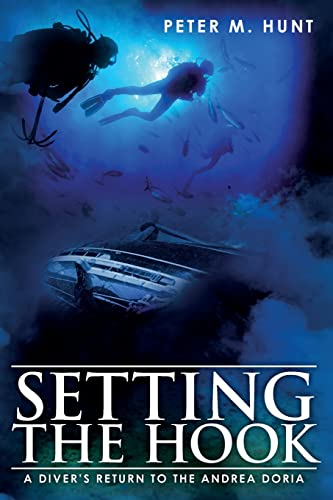
The 1956 collision of the Andrea Doria and the Stockholm triggered a night of sheer terror for the Andrea Doria’s 1,706 passengers and crew and set in motion one of history’s most dramatic rescues at sea. From the moment the Andrea Doria settled on the sea floor in 240 feet of water, skilled sport divers have risked their lives to simply touch the “Mount Everest of wreck diving.” Not all returned alive. Peter Hunt crewed on five Andrea Doria expeditions during the early 1980s before becoming a Navy pilot and settling in Washington State. Nearly twenty years after first exploring the Andrea Doria - and following twelve months of training in the sport’s amazing advances in equipment and techniques - Hunt hugged his wife and children goodbye and returned to New York to dive the Andrea Doria once again. The experience transformed him forever. Setting the Hook explores the Andrea Doria through an introspective odyssey of memory, heart-pounding adventure, and history as thirty years of extreme diving and enduring friendships merge in a personal tale of learning to accept life’s oldest challenge.
A deep-sea diver explores shipwrecks and his own character in this gripping scuba memoir.
Hunt (Angles of Attack: An A-6 Intruder Pilot’s War, 2002) revisits 30 years of shipwreck dives, a pastime whose lugubrious allure is only heightened by his vivid descriptions of the dangers. Chief among these are the hulks themselves, full of ensnaring electrical cables and silt, all of which becomes an impenetrable, disorienting cloud at the kick of a fin; one wrong turn in these pitch-black labyrinths, and a diver can be trapped in a watery tomb. Then there’s the sheer physiological challenge of penetrating an alien environment where breathing itself is a high-tech feat rife with fatal glitches. Carbon dioxide can build up to asphyxiating levels; nitrogen first intoxicates and then bubbles out of the blood to cause the bends; even oxygen becomes toxic and induces convulsions. Hunt’s well-paced narrative is full of underwater panics, nerve-wracking escapes and rescues that sometimes end in failure and death. He structures it around his dives to the wreck of the Italian cruise ship Andrea Doria, which sank in 240 feet of water off Nantucket in 1956—he includes a riveting account of the disaster and the blunders that caused it—and remains a magnet to divers because of its difficulty and wealth of fine china and other loot. Along the way he presents a lucid, engrossing study of the art of diving, introducing readers to the arcane gear, the constant attention to breathing, buoyancy and “situational awareness” the sport demands and the complex decompression routines that make surfacing take twice as long as the dive. Hunt’s three decades of Andrea Doria excursions also frame an affecting story of maturation and limits, as he ages from a strapping, reckless youth to a more cautious man in physical decline—a transformation that prepares him for the onset of Parkinson’s disease with the knowledge that “dying slowly is hard work.”
Hunt’s taut scenes and meticulous prose will have readers holding their breath, but his saga probes hidden depths as well.