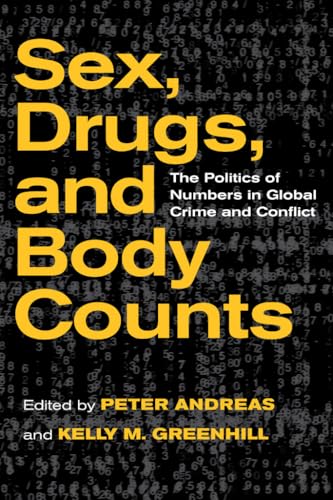
Sex, Drugs, and Body Counts (Paperback)
Peter Andreas
Sold by Grand Eagle Retail, Bensenville, IL, U.S.A.
AbeBooks Seller since October 12, 2005
New - Soft cover
Condition: New
Ships within U.S.A.
Quantity: 1 available
Add to basketSold by Grand Eagle Retail, Bensenville, IL, U.S.A.
AbeBooks Seller since October 12, 2005
Condition: New
Quantity: 1 available
Add to basketPaperback. Big, attention-grabbing numbers are frequently used in policy debates and media reporting: "At least 200,000-250,000 people died in the war in Bosnia." "There are three million child soldiers in Africa." "More than 650,000 civilians have been killed as a result of the U.S. occupation of Iraq." "Between 600,000 and 800,000 women are trafficked across borders every year." "Money laundering represents as much as 10 percent of global GDP." "Internet child porn is a $20 billion-a-year industry." Peter Andreas and Kelly M. Greenhill see only one problem: these numbers are probably false. Their continued use and abuse reflect a much larger and troubling pattern: policymakers and the media naively or deliberately accept highly politicized and questionable statistical claims about activities that are extremely difficult to measure. As a result, we too often become trapped by these mythical numbers, with perverse and counterproductive consequences. This problem exists in myriad policy realms.But it is particularly pronounced in statistics related to the politically charged realms of global crime and conflict-numbers of people killed in massacres and during genocides, the size of refugee flows, the magnitude of the illicit global trade in drugs and human beings, and so on. In Sex, Drugs, and Body Counts, political scientists, anthropologists, sociologists, and policy analysts critically examine the murky origins of some of these statistics and trace their remarkable proliferation. They also assess the standard metrics used to evaluate policy effectiveness in combating problems such as terrorist financing, sex trafficking, and the drug trade. Contributors: Peter Andreas, Brown University; Thomas J. Biersteker, Graduate Institute of International and Development Studies-Geneva; Sue E. Eckert, Brown University; David A. Feingold, Ophidian Research Institute and UNESCO; H. Richard Friman, Marquette University; Kelly M. Greenhill, Tufts University and Harvard University; John Hagan, Northwestern University; Lara J.Nettelfield, Institut Barcelona D'Estudis Internacionals and Simon Fraser University; Wenona Rymond-Richmond, University of Massachusetts Amherst; Winifred Tate, Colby College; Kay B. Warren, Brown University In this book, political scientists, anthropologists, sociologists, and policy analysts critically examine the murky origins of misleading or inaccurate statistics used in global policy and traces their remarkable proliferation. Shipping may be from multiple locations in the US or from the UK, depending on stock availability.
Seller Inventory # 9780801476181
At least 200,000-250,000 people died in the war in Bosnia. "There are three million child soldiers in Africa." "More than 650,000 civilians have been killed as a result of the U.S. occupation of Iraq." "Between 600,000 and 800,000 women are trafficked across borders every year." "Money laundering represents as much as 10 percent of global GDP." "Internet child porn is a $20 billion-a-year industry." These are big, attention-grabbing numbers, frequently used in policy debates and media reporting. Peter Andreas and Kelly M. Greenhill see only one problem: these numbers are probably false. Their continued use and abuse reflect a much larger and troubling pattern: policymakers and the media naively or deliberately accept highly politicized and questionable statistical claims about activities that are extremely difficult to measure. As a result, we too often become trapped by these mythical numbers, with perverse and counterproductive consequences.
This problem exists in myriad policy realms. But it is particularly pronounced in statistics related to the politically charged realms of global crime and conflict-numbers of people killed in massacres and during genocides, the size of refugee flows, the magnitude of the illicit global trade in drugs and human beings, and so on. In Sex, Drugs, and Body Counts, political scientists, anthropologists, sociologists, and policy analysts critically examine the murky origins of some of these statistics and trace their remarkable proliferation. They also assess the standard metrics used to evaluate policy effectiveness in combating problems such as terrorist financing, sex trafficking, and the drug trade.
"About this title" may belong to another edition of this title.
We guarantee the condition of every book as it¿s described on the Abebooks web sites. If you¿ve changed
your mind about a book that you¿ve ordered, please use the Ask bookseller a question link to contact us
and we¿ll respond within 2 business days.
Books ship from California and Michigan.
Orders usually ship within 2 business days. All books within the US ship free of charge. Delivery is 4-14 business days anywhere in the United States.
Books ship from California and Michigan.
If your book order is heavy or oversized, we may contact you to let you know extra shipping is required.
| Order quantity | 6 to 16 business days | 6 to 14 business days |
|---|---|---|
| First item | US$ 0.00 | US$ 0.00 |
Delivery times are set by sellers and vary by carrier and location. Orders passing through Customs may face delays and buyers are responsible for any associated duties or fees. Sellers may contact you regarding additional charges to cover any increased costs to ship your items.