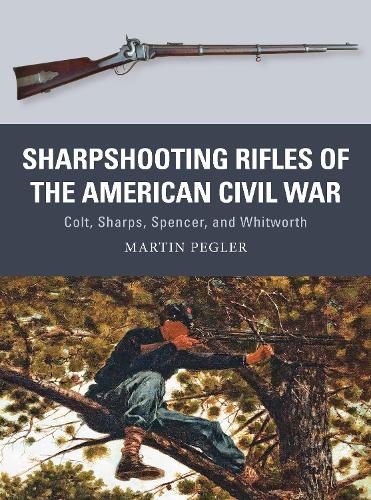
At the outset of the American Civil War, the wealthy inventor and expert shot Hiram Berdan initiated the setting-up of sharpshooting units in the Union Army; these units would be tasked primarily with open-order skirmishing, but also with long-range, accurate shooting. Initially, it was envisaged that the M1855 Colt revolving rifle would be the weapon employed by these specialists. Available in .36, .44, and .56 caliber, the M1855 swiftly earned a poor reputation, however, as it was prone to a malfunction known as “chain fire,” in which powder in all the unfired chambers would be ignited, seriously injuring the shooter.
Instead, the North's sharpshooters preferred the Sharps rifle, an innovative breech-loading weapon employing a falling-block action. It had double-set triggers, aiding accuracy, and could fire up to ten shots per minute--more than three times the rate of fire offered by the standard-issue Springfield .58-caliber rifled musket. The Sharps was very expensive, though, and military planners believed it would encourage soldiers to waste ammunition. After a prolonged fight with the Ordnance Department, however, Berdan succeeded in procuring Sharps rifles for his men. Other Union sharpshooters were equipped with the standard-issue Springfield rifled musket, the .56-56-caliber Spencer Repeating Rifle--a lever-action weapon with a seven-round tube magazine--or “target rifles,” basically sporting rifles repurposed for military use.
Conversely, the Confederacy favored the Pattern 1853 Enfield rifled musket for its sharpshooters; the South also imported from Britain quantities of the Whitworth Rifle, a .45-caliber, single-shot, muzzle-loading weapon distinguished by its use of a twisted hexagonal barrel. More prone to fouling and slower-firing than the standard-issue rifled musket, the Whitworth offered impressive long-range accuracy; its hexagonal bullets made a distinctive whistling noise in flight. In May 1864 a Confederate sharpshooter armed with the Whitworth famously killed the highest-ranking Union battle casualty of the conflict, Major General John Sedgwick, at a range of about 1,000 yards.
Featuring specially commissioned artwork, this is the engrossing story of the innovative rifles that saw combat in the hands of sharpshooters on both sides during the Civil War.
Martin Pegler has a BA Hons in Medieval and Modern History and an MA in Museum Studies, both from University College, London, and was for many years the Senior Curator of Firearms at the Royal Armouries Museum, Leeds. Martin has established The Somme Historical Centre (www.martinpegler.com), where visitors can see the technology used in the 1914-18 trench warfare. He is currently an author and firearms consultant and he also lectures at local Great War museums.
He is the author of a number of books including The Military Sniper since 1914 (Osprey, 2001), Firearms in the American West 1700-1900 (The Crowood Press, 2002), and the highly acclaimed Out of Nowhere: A History of the Military Sniper (Osprey, 2004). In the 1980s he had the privilege of interviewing many World War I veterans about their wartime experiences, and the recordings are now part of the sound archives of the Imperial War Museum, London.
Johnny Shumate works as a freelance illustrator living in Nashville, Tennessee. He began his career in 1987 after graduating from Austin Peay State University. Most of his work is rendered in Adobe Photoshop using a Cintiq monitor. His greatest influences are Angus McBride, Don Troiani, and Édouard Detaille.
Alan Gilliland, a contributor to more than 70 Osprey titles, notably in the Weapon series, writes, illustrates and publishes fiction (www.ravensquill.com), as well as illustrating for a variety of publishers (alangillilandillustration.blogspot.com).