
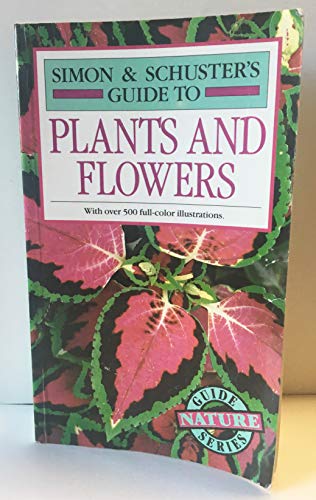
Simon & Schuster's Guide to Plants and Flowers
Simon and Schuster Staff
ISBN 10: 0671222473 ISBN 13: 9780671222475
Published by Fireside, 1976
Used
Paperback
From
ThriftBooks-Atlanta, AUSTELL, GA, U.S.A.
Seller rating 5 out of 5 stars

AbeBooks Seller since March 24, 2009
This specific item is no longer available.
About this Item
Description:
Pages are clean and are not marred by notes or folds of any kind. ~ ThriftBooks: Read More, Spend Less. Seller Inventory # G0671222473I2N00
Synopsis:
Describes and notes the families, places of origin, flowering times, uses, and light and soil-moisture requirements of a variety of shrubs, succulents, cacti, and flowering, climbing, Mediterranean, and rock-garden plants
Excerpt. © Reprinted by permission. All rights reserved.:
Chapter 1
1 MAIDENHAIR FERN
Adianthum capillus-veneris:
Family: Adiantaceae. Name from Greek adiantos, dry; the fronds repel water, a property first recorded by Theophrastus.
Place of origin: cosmopolitan; rare in Britain.
Description: a lovely and delicate deciduous fern with many basal fronds; numerous pinnules (small leaves) which are dark green, kidney-shaped, crenulate or lobate on the upper edge. Many distinct varieties once grown hut now largely disappeared.
Use: as an indoor plant, or to decorate walls and recesses and damp, shady rockeries.
Planting: spring. Keep rhizomes near soil surface. For pot use, supply good drainage and a little time.
Propagation: by division and by spores sown on damp peat and sand, covered with glass to maintain humidity.
Environment and light: adequate hut not direct light, with fairly high humidity level. Avoid hot places, move as little as possible. Slight frost injures fronds; severe frost kills.
Type of soil: ordinary garden soil with peat.
Soil moisture: water plentifully during growing season; in winter keep soil moist only.
2 ARALIA misnamed CASTOR-OIL PLANT
Aralia sieboldii (more correctly Fatsia japonica):
Family: Araliaceae. Name adapted from the Japanese name for this plant Fat Si.
Place of origin: Japan; introduced into Europe in 1838.
Description: a slow growing evergreen plant with large, bright green, smooth, shiny leaves with 7 or 9 (rarely 11) pointed, oblong lobes. Flowers on branching panicles in round, milky-white heads, succeeded by round, black, ivy-like berries.
Flowering time: autumn to winter.
Use: where hardy (temperate climates) makes a useful winter flowering shrub. The cream-splashed leaves of the variety variegata make this a good house plant for cool rooms.
Propagation: by cuttings from sucker shoots in spring, or by division.
Environment and light: adequate light indoors but never in direct sun. Half-shade outdoors.
Type of soil: any good garden soil outdoors; loam, peat or leaf mould and sand (equal parts) for pot work.
Soil moisture: water only when required.
Remarks: shorten straggly growths in spring.
3 ASPARAGUS FERN
Asparagus sprengeri (now more correctly A. densiflorus "Sprengeri"):
Family: Liliaceae. Name given by Theophrastus.
Place of origin: Southern Africa; introduced into Europe in 1890.
Description: a woody stemmed plant with long trailing (or widely climbing) branches 2-6 ft. (1-2 m) long, armed with small hooked prickles and small, flat, evergreen phylloclades, mostly in threes and 1-1 1/2 in. (2.5-4 cm) long. Flowers tiny, white or pinkish, fragrant, in racemes. Fruit: bright red 1/2 in. (1 cm) berries.
Flowering time: early summer.
Use: as an indoor plant, especially suitable for hanging baskets.
Propagation: by division in spring or seed.
Environment and light: ample ventilation, plenty of light, but not direct sun.
Type of soil: dry, permeable and rich. If the soil is not sufficiently rich, the branches of the plant will droop. Feed in summer.
Soil moisture: water regularly, more frequently in the summer months.
Remarks: dwarfs and variegated forms occur.
4 ASPIDISTRA
Aspidistra elatior (A. lurida):
Family: Liliaceae. Name from Greek aspidion, a small round shield, referring to shape of stigma.
Place of origin: Central-eastern Asia; introduced 1822.
Description: perennial plants with underground rhizomatic sterns, long and large radical leaves, upright and well stemmed, with complete, leathery, shiny green lamina, narrowing to a channelled stalk one-third the length of the blade. Purple, insignificant flowers close to ground. Also a variegated green and white leafed variety.
Flowering time: seldom; summer.
Use: withstands poor soil and light and considerable neglect, but needs good light for robust health.
Propagation: by division towards the end of autumn.
Environment and light: needs good light, but not sun; without adequate light the leaves become less shiny. Outdoors it grows well in warm, shady places.
Type of soil: ordinary soil with sand and peat, always with a little organic matter.
Soil moisture: water regularly two or three times weekly, and more often in summer.
Copyright © 1974 by Arnoldo Mandadori Editore, Milano
"About this title" may belong to another edition of this title.
Bibliographic Details
Title: Simon & Schuster's Guide to Plants and ...
Publisher: Fireside
Publication Date: 1976
Binding: Paperback
Condition: As New
Dust Jacket Condition: No Jacket