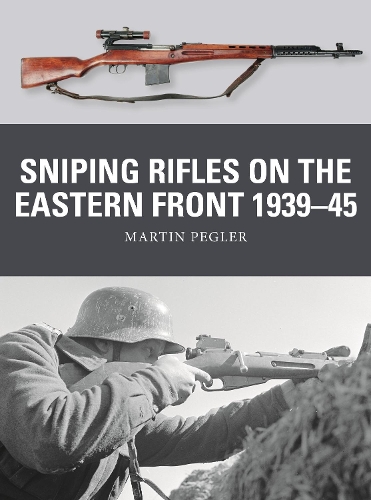
Sniping Rifles on the Eastern Front 1939-45
Book 66 of 86: WeaponMartin Pegler
Sold by Rarewaves USA, OSWEGO, IL, U.S.A.
AbeBooks Seller since June 10, 2025
New - Soft cover
Condition: New
Ships within U.S.A.
Quantity: 20 available
Add to basketSold by Rarewaves USA, OSWEGO, IL, U.S.A.
AbeBooks Seller since June 10, 2025
Condition: New
Quantity: 20 available
Add to basketThe Soviet Union had developed a significant sniping force by 1939, but the extraordinary skill and cunning displayed by Finnish snipers during the Winter War forced the Soviets to innovate.On the other side, German sniping suffered from a lack of standardization of weapons and a lack of marksmen deployed at the start of the Great Patriotic War (1941-45). There were few heroes in the conflict, but on both sides, the snipers were idolized - especially on the Soviet side, gaining almost mythical status.As well as traditional bolt-action weapons, both sides used several types of semi-automatic rifle, such as the SVT-38 and the Gew 41. Offering greater firepower at the expense of long-range accuracy, such weapons would be profoundly influential in the postwar world.Fully illustrated, this absorbing study investigates the development of sniping weapons and techniques on World War II's Eastern Front.
Seller Inventory # LU-9781472825896
Fully illustrated, this absorbing study investigates the development of sniping weapons and techniques on World War II's Eastern Front.
The Soviet Union had developed a significant sniping force by 1939, but the extraordinary skill and cunning displayed by Finnish snipers during the Winter War forced the Soviets to innovate. On the other side, German sniping suffered from a lack of standardization of weapons and a lack of marksmen deployed at the start of the Great Patriotic War (1941–45). There were few heroes in the conflict, but on both sides, the snipers were idolized – especially on the Soviet side gaining almost mythical status.
As well as traditional bolt-action weapons, both sides used several types of semi-automatic rifle, such as the SVT-38 and the Gew 41. Offering greater firepower at the expense of long-range accuracy, such weapons would be profoundly influential in the postwar world.
Martin Pegler has a BA Hons in Medieval and Modern History and an MA in Museum Studies, both from University College, London, and was for many years the Senior Curator of Firearms at the Royal Armouries Museum, Leeds. Martin has established The Somme Historical Centre (www.martinpegler.com), where visitors can see the technology used in the 1914-18 trench warfare. He is currently an author and firearms consultant and he also lectures at local Great War museums.
He is the author of a number of books including The Military Sniper since 1914 (Osprey, 2001), Firearms in the American West 1700-1900 (The Crowood Press, 2002), and the highly acclaimed Out of Nowhere: A History of the Military Sniper (Osprey, 2004). In the 1980s he had the privilege of interviewing many World War I veterans about their wartime experiences, and the recordings are now part of the sound archives of the Imperial War Museum, London.
"About this title" may belong to another edition of this title.
Please note that we do not offer Priority shipping to any country.
We currently do not ship to the below countries:
Afghanistan
Bhutan
Brazil
Brunei Darussalam
Channel Islands
Chile
Israel
Lao
Mexico
Russian Federation
Saudi Arabia
South Africa
Yemen
Please do not attempt to place orders with any of these countries as a ship to address - they will be cancelled.
| Order quantity | 8 to 11 business days | 8 to 11 business days |
|---|---|---|
| First item | US$ 0.00 | US$ 0.00 |
Delivery times are set by sellers and vary by carrier and location. Orders passing through Customs may face delays and buyers are responsible for any associated duties or fees. Sellers may contact you regarding additional charges to cover any increased costs to ship your items.