Synopsis
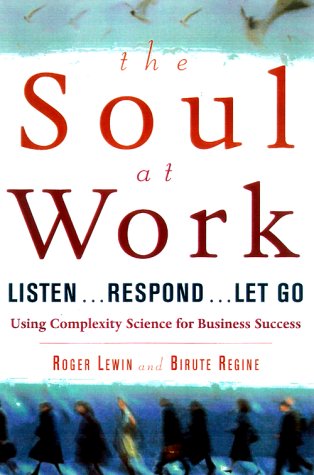
Shows how to use complexity science to make businesses more flexible and spur employees to become more involved with their work
Reviews
Organizational theorists have begun to look at the traits of complex adaptive systems to help understand how organizations work. At their conferences and in their papers, they rely on computer algorithms and mathematical models to make their arguments. Skeptics, though, ask, "What about people?" Lewin and Regine, neither of whom are managers, attempt to answer that question. Lewin is a popular science writer and the author of Complexity: Life at the Edge of Chaos (1992). Regine is a developmental psychologist who has investigated the "complexity of relational dynamics within human systems," such as families. Relations are the focus here. Complexity theory analyzes the mutual effect on one another when agents interact. In management, "agents" as often as not are people. The authors introduce the basic ideas behind complexity science and tell the "stories" of people's experiences at organizations that have begun to understand and attend to the interactions of people within them so that they become the "source of novelty, creativity, and adaptability." David Rouse
In a nutshell, "complexity science" refers to how things interact with each other in the natural world. Lewin and Regine, respected academics and authors, attempt to build on this model, pointing out its applications in the business world. The world is often chaotic, though properly challenged people can often surmount and even thrive amidst the chaos. But what does this have to do with business? The authors argue convincingly that the old mechanistic, command-and-control workplace model has outlived its purpose. Industry is "in the throes of revolutionary changes," and companies must see themselves as "complex adaptive systems" more akin to "environmental ecosystems." Employees are not cogs but people, and authentic employer-enployee relationships must be cultivated. Does this sound like the latest flavor-of-the-month management trend? Perhaps. But the authors are onto something here. Surveying a number of companies in both the United States and England, they show how large and small businesses that have embraced the principles of "complexity science" have turned themselves around, often dramatically, with improved profits and, more significantly, a more humane workplace for management and employees alike. Recommended for larger business collections.ARichard S. Drezen, Washington Post News Research Ctr., Washington, DC
Copyright 1999 Reed Business Information, Inc.
"About this title" may belong to another edition of this title.