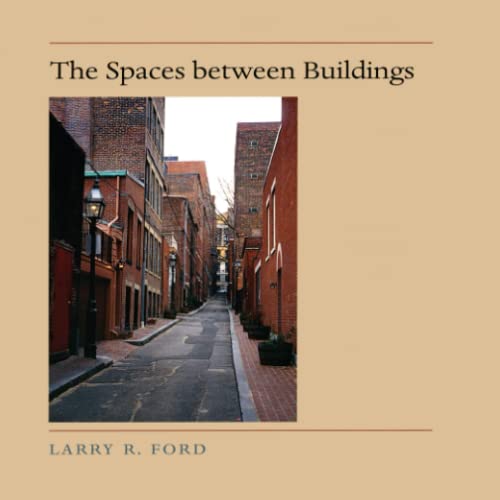
Gates and fences, sidewalks and driveways, alleys and parking lots―these ordinary features have an important architectural impact, influencing how a building relates to the spaces around it. As geographer Larry R. Ford argues, architectural histories and guidebooks tell us surprisingly little about the character of American cities because they concentrate on buildings taken out of context, buildings divorced from space. In The Spaces between Buildings, Ford focuses on the neglected "nooks and crannies" between structures, supplementing his analysis with three photographic essays.
Long before Ford knew anything about geography or architecture, he was a connoisseur of front porches, alleys, and loading docks. As a kid in Columbus, Ohio, he knew where to find coal chutes to play in, which rooftops and fire escapes were ideally suited for watching parades, and which stoops were perfect for waiting for a bus. To him the spaces between buildings seemed wonderfully integrated and connected. The Spaces between Buildings is the result of Ford's preoccupation with the relationship of buildings to one another and how their means of access and boundaries organize the areas around us.
As Ford observes, a city with friendly, permeable facades and a great variety of street-level doors is more conducive to civic life than a city characterized by fortresslike structures with blank walls and invisible doors. Life on the street is defined and guided by the nature of the surrounding buildings. Similarly, a residential neighborhood with front porches, small lawns or gardens, and houses with lots of windows and architectural details presents a more walkable and gregarious setting than a neighborhood where public space is surrounded by walls, three-car garage doors, blank facades, and concrete driveways.
Ford begins by looking at the growth of four urban places, each representing a historical era as much as a geographic location: the Islamic medina; the city shaped by the Spanish renaissance; the nineteenth-century North American city; and the twentieth-century American city. His first essay also discusses the evolution of the free-standing structure as a basic urban building type and the problems encountered in beautifying the often work-a-day back and side yards that have helped to create the image of the untidy American city. The second essay examines the urban trend toward viewing lawns, gardens, hedges, and trees as an essential adjunct to architecture. The final essay focuses on pedestrian and vehicular spaces. Here the author includes the landscape of the garage, sidewalks, streets, and alleys.
In its exploration of how spaces become places, The Spaces between Buildings invites readers to see anew the spaces they encounter every day and often take for granted.