
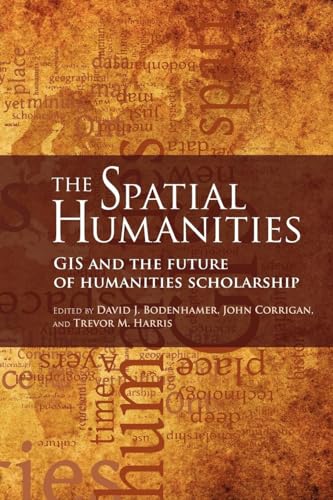
The Spatial Humanities : GIS and the Future of Humanities Scholarship
ISBN 10: 0253222176 ISBN 13: 9780253222176
Published by Wiley & Sons, Limited, John, 2010
Used
Soft cover
From
Better World Books, Mishawaka, IN, U.S.A.
Seller rating 5 out of 5 stars

AbeBooks Seller since August 3, 2006
This specific item is no longer available.
About this Item
Description:
Pages intact with minimal writing/highlighting. The binding may be loose and creased. Dust jackets/supplements are not included. Stock photo provided. Product includes identifying sticker. Better World Books: Buy Books. Do Good. Seller Inventory # 7921375-6
Synopsis:
Geographic information systems (GIS) have spurred a renewed interest in the influence of geographical space on human behavior and cultural development. Ideally GIS enables humanities scholars to discover relationships of memory, artifact, and experience that exist in a particular place and across time. Although successfully used by other disciplines, efforts by humanists to apply GIS and the spatial analytic method in their studies have been limited and halting. The Spatial Humanities aims to re-orient―and perhaps revolutionize―humanities scholarship by critically engaging the technology and specifically directing it to the subject matter of the humanities. To this end, the contributors explore the potential of spatial methods such as text-based geographical analysis, multimedia GIS, animated maps, deep contingency, deep mapping, and the geo-spatial semantic web.
About the Author:
David J. Bodenhamer is Executive Director of the Polis Center and Professor of History at Indiana University Purdue University Indianapolis.
John Corrigan is Lucius Moody Bristol Distinguished Professor of Religion and Professor of History at Florida State University.
Trevor M. Harris is Eberly Professor of Geography and Chair of the Department of Geology and Geography at West Virginia University.
"About this title" may belong to another edition of this title.
Bibliographic Details
Title: The Spatial Humanities : GIS and the Future ...
Publisher: Wiley & Sons, Limited, John
Publication Date: 2010
Binding: Soft cover
Condition: Good