About this Item
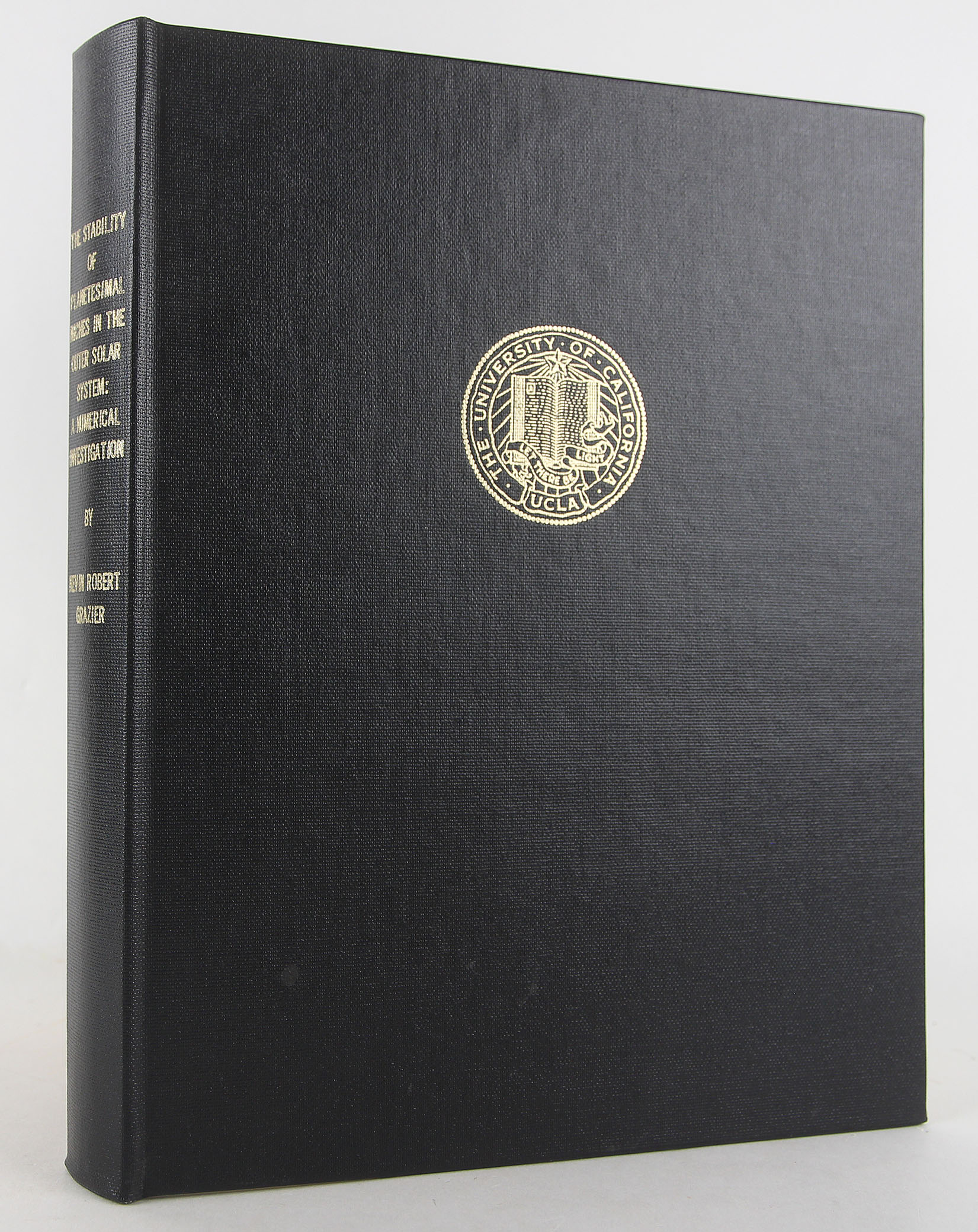
1997 University of California, Los Angeles (Los Angeles, California), 8 3/4 x 11 inches tall black buckram cloth hardcover, no dust jacket (as issued), gilt UCLA crest to front cover, gilt lettering to spine, copiously illustrated with charts, diagrams and formulae, bibliography, xiv, 198 pp. A near fine copy - clean, bright and unmarked. Note that this is a heavy and oversized book, so additional postage will be required for international or priority orders. ~C~ [4.0P] The 1997 UCLA doctoral dissertation for Kevin R. Grazier, an American planetary physicist now known for his work on the Cassini/Huygens Mission to Saturn and Titan where he had the dual roles of Science Planning Engineer and Investigation Scientist for the Imaging Science Subsystem instrument. He is an expert in computational methods and planetary dynamics and performs large-scale, long-term simulations of early Solar System evolution, dynamics, and chaos. Grazier has over two dozen technical publications in planetary science, astrobiology, numerical analysis, computer science, and spacecraft operations journals. He is also the science consultant for several television series and movies. Planetesimals are objects, such as asteroids and comets, that formed from the early solar nebula and represent an early stage in the planetary accretion process. Planetesimals appear to be absent from the zones between the jovian planets. This could be due to observational bias, an ab initio depletion in the early solar nebula, or perturbations from the jovian planets which destabilize these inter-planet niches over time scales shorter than the age of the Solar System. We computationally tested the third hypothesis, and reconsidered the possible existence of dynamically stable niches in the Jupiter/Saturn, Saturn/Uranus, and Uranus/Neptune zones. Previous computational surveys of these zones have been coarse, employing statistically small numbers of test particles, and introducing many simplifying physical assumptions. We employed a modified 13th order Stormer integrator together with 'significance ordered computation' for roundoff error management. We first validated our new numerical techniques, and compared them with popular symplectic mapping methods-confirming their much improved accuracy, albeit at the expense of significantly more computer time. By employing 105 particles in the Jupiter/Saturn zone (two orders of magnitude more than in previous studies)-and 104 in each of the Saturn/Uranus and Uranus/Neptune zones-on both inclined and eccentric orbits, we performed a more comprehensive search for test particle stability as a function of initial orbital elements. Our increased number of test particles also facilitated robust statistical inference and comparison with results derived from statistical mechanics and kinetic theory. We found that most planetesimals are removed over 105 years in the Jupiter/Saturn zone, and 107 years in the Saturn/Uranus and Uranus/Neptune zones. Five long-lived regions persisted for 108 years, but few planetesimals survived one billion years. that were expelled from these jovian niches. We developed two new integration schemes, a time-adaptive multistep method and a new symplectic mapping that exploited the integrability of the Stark effect. Our expectation is that these new tools will be employed in the next generation of Solar System evolution investigations.
Seller Inventory # C-0352-14826
Contact seller
Report this item