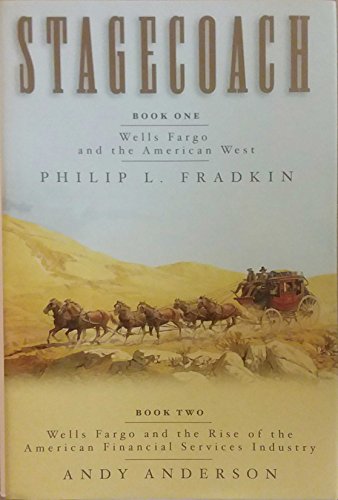
STAGECOACH
Book I: Wells Fargo and the American West
Book II: Wells Fargo and the Rise of the American Financial Services Industry
Sweeping across prairie, plain, and mountain range, Stagecoach is the epic story of an American original, a business with the peculiar American talent for reinvention -- Wells Fargo.
It's the story of a transportation-communications-financial-services network that had the audacity to survive the blizzards of the century, plagues of locusts, devastating earthquakes and fires, panics and depressions, and a civil war and world wars. From telegraph to Internet, Wells Fargo became an icon of the American West and a bastion of American finance.
For some, Wells Fargo was "the greatest universal service company ever invented." It built its reputation in an era when companies were either in-business or out-of-business solely on the basis of their integrity and dependability. There were no safety nets and hardly any government.
For others, Wells Fargo was a vast domain of gold and banks and bullion vaults that housed and moved the nation's mineral and agricultural wealth from the Middle and Far Western "frontier" to the "civilization" of the East.
Powerful images of Wells Fargo stagecoaches, Pony Express riders, transcontinental railroads, and telegraph lines combine with the vast spaces and abundance of the American landscape and the energy of American technology to paint the portrait of a company that has fed the nation and moved its money -- securely and speedily -- for 150 years.
Along the way, America grew from 20 million to 280 million people. Entrepreneurs and dreamers, farmers and mechanics, small businesses and global enterprises used the company's services alongside Wyatt Earp, Black Bart, Buffalo Bill, Levi Strauss, Amelia Earhart, and a host of other American originals.
Sweeping in scope, as revealing of an era as it is of a company, Stagecoach is a wonderfully unique look at Wells Fargo as part of the history of the American West by Pulitzer Prize-winning author Philip L. Fradkin, and as part of the history of American enterprise by Wells Fargo's chief historian, Dr. Andy Anderson.
Today, most of us know the iconic red and yellow image of the Wells Fargo stagecoach only as the omnipresent logo of a huge national financial institution. Philip L. Fradkin's Stagecoach reminds us of the far more complex and colorful history of the 150-year-old enterprise it symbolizes, beginning with its heyday as an unpolished but honorable "express company" that dependably linked, by means of the stagecoach, an upstart West Coast and roughshod Rockies with everything else back East. Fradkin, author of eight books on the American West, ties the company's and region's fates together as mining, agriculture, and then more contemporary commercial interests (with help from the federal government) indelibly shaped them both. From the time of the dusty stage driver to the era of the wing-tipped banker, the book recounts it all but wisely focuses on the period from 1852 to 1918, a time when the firm "served as the principal communications conduit between East and West ... contributed to the Union victory in the Civil War ... and shipped fresh vegetables and fruits via fast refrigerated express." After reading it, you'll be hard-pressed to look at the enduring stagecoach imagery in quite the same way ever again. --Howard Rothman