About this Item
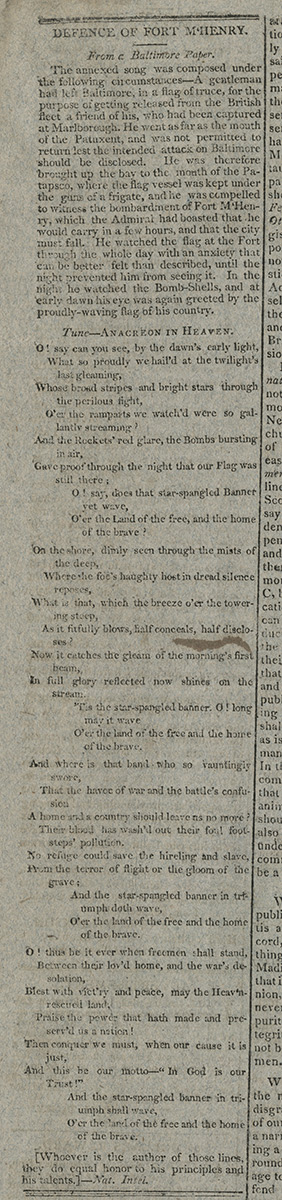
National Intelligencer, September 27, 1814. Washington, DC: Gales & Seaton. 4 pp., 12? x 20 1/2 in. This issue of the National Intelligencer contains an early printing of Francis Scott Key's song "The Defence of Fort M'Henry," which later became the "Star-Spangled Banner." Key set the verses to the melody of the popular British tune, "Anacreon in Heaven." Although Key's identity as the author was first revealed in the Frederick-Town Herald on September 24, the editors of the National Intelligencer had not yet learned this information. This issue appeared seven days after the song's first appearance in the Baltimore Patriot and Evening Advertiser on September 20, 1814, and one day after it appeared in the Daily National Intelligencer on September 26. Excerpts"DEFENCE OF FORT M'HENRY"From a Baltimore Paper."The annexed song was composed under the following circumstances - A gentleman had left Baltimore, in a flag of truce, for the purpose of getting released from a British fleet a friend of his, who had been captured at Marlborough. He went as far as the mouth of the Patuxent, and was not permitted to return lest the intended attack on Baltimore should be disclosed. He was therefore brought up the bay to the mouth of the Patapsco, where the flag vessel was kept under the guns of a frigate, and he was compelled to witness the bombardment of Fort M'Henry, which the Admiral had boasted that he would carry in a few hours, and that the city must fall. He watched the flag at the Fort through the whole day with an anxiety that can be better felt than described, until the night prevented him from seeing it. In the night he watched the Bomb-Shells, and at an early dawn his eye was again greeted by the proudly-waving flag of his country."Tune-Anacreon in Heaven."O! say can you see, by the dawn's early light, What so proudly we hail'd at the twilight's last gleaming,Whose broad stripes and bright stars through the perilous fight, O'er the ramparts we watch'd, were so gallantly streaming? And the rockets' red glare, the bombs bursting in air, Gave proof through the night that our flag was still there 3/4 O! say, does that star-spangled banner yet wave O'er the land of the free, and the home of the brave?"On the shore, dimly seen through the mists of the deep, Where the foe's haughty host in dread silence reposes,What is that, which the breeze o'er the towering steep, As it fitfully blows, half conceals, half discloses? Now it catches the gleam of the morning's first beam, In full glory reflected now shines on the stream. 'Tis the star-spangled banner, O! long may it wave O'er the land of the free, and the home of the brave."And where is that band who so vauntingly swore That the havoc of war and the battle's confusionA home and a country should leave us no more? Their blood has wash'd out their foul foot-steps' pollution. No refuge could save the hireling and slave, From the terror of flight or the gloom of the grave; And the star-spangled banner in triumph doth wave, O'er the land of the free, and the home of the brave."O! thus be it ever when freemen shall stand, Between their lov'd home, and the war's desolation,Blest with vict'ry and peace, may the Heav'n-rescued land, Praise the power that hath made and preserv'd us a nation! Then conquer we must, when our cause it is just, And this be our motto 3/4'In God is our trust!' And the star-spangled banner in triumph shall wave, O'er the land of the free, and the home of the brave."[Whoever is the author of those lines, they do equal honor to his principles and his talents.]-Nat. Intel." (p4/c1)Historical BackgroundOn August 24, 1814, both President James Madison and Secretary of State James Monroe were present with American defenders at Bladensburg, Maryland. The British under Major General Robert Ross routed the defenders, forcing an American retreat that came to be known as the "Bladensburg Races." The way was now clear for the invaders to move on the nation. (See website for full descript.
Seller Inventory # 26266
Contact seller
Report this item