About this Item
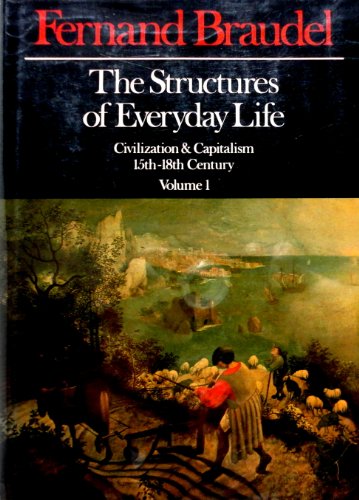
623, [1] pages. This Volume of Trilogy ONLY. Illustrations. Notes. Index. The dust jacket has a small tear from the top of the spine down about an inch. Fernand Paul Achille Braudel (24 August 1902-27 November 1985) was a French historian. His scholarship focused on three main projects: The Mediterranean (1923-49, then 1949-66), Civilization and Capitalism (1955-79), and the unfinished Identity of France (1970-85). He was a member of the Annales School of French historiography and social history in the 1950s and 1960s. Braudel emphasized the role of large-scale socioeconomic factors in the making and writing of history. In a 2011 poll by History Today magazine, he was named the most important historian of the previous 60 years. At the outbreak of war in 1939, he was called up for military service and on 29 June 1940 taken prisoner as lieutenant in the 156th Infantry Regiment. He was held at prisoner-of-war camp Oflag XII-B in Mainz. He became the rector of the camp university, which gained him respectful treatment from the authorities and the right to borrow books and journals from the municipal library for his research. Under the Geneva Convention he received his pay, which he used to buy German books, and was able to order material from France. In June 1942, suspected of "Gaullist" (i.e. French Resistance) involvement, he was transferred to a camp for special category prisoners (Oflag X-C) near Lübeck, where he remained for the rest of the war. Braudel became the leader of the second generation of Annales historians after 1945. He defended his thesis at the University of Paris in 1947. He became the editor-in-chief of the Annales in 1957, which completed his rise to unrivaled influence on the development of the historical studies in France in the post-war years. This is the first of three fascinating volumes in which Braudel, the renowned historian and celebrated author of The Mediterranean and the Mediterranean World, offers what is in effect an economic and social history of the world from the Middle Ages to the Industrial Revolution. Like everything he writes, it is new, stimulating and sparkles like champagne. Braudel's technique, it has been said, is that of a pointilliste. Myriads of separate details, sharp glimpses of reality experienced by real people, are seen miraculously to orchestrate themselves into broad rhythms that underlie and transcend the excitements and struggles of particular periods. Braudel sees the past as we see the present - only in a longer perspective and over a wider field. The perspective is that of the possible, of the actual material limitations to human life in any given time or place. It is the everyday, the habitual - the obvious that is so obvious it has hitherto been neglected by historians - that Braudel claims for a new and vast and enriching province of history. Food and drink, dress and housing, demography and family structure, energy and technology, money and credit, and, above all, the growth of towns, that powerful agent of social and economic development, are described in all the richness and complexity of real life. The intensely visual quality of Braudel's understanding of history is brought into sharper focus by the remarkable series of illustrations that of themselves would make this book incomparable. After La Méditerranée, Braudel's most famous work is Civilisation Matérielle, Économie et Capitalisme, XVe-XVIIIe ("Civilization and Capitalism, 15th-18th Century"). The first volume was published in 1967 and was translated to English in 1973. The last of the three-volume work appeared in 1979. The work is a broad-scale history of the pre-industrial modern world focusing on how regular people made economies work. Like all of Braudel's other major works, it mixes traditional economic material with thick description of the social impact of economic events on various facets of everyday life, including food, fashion and other social customs. Braudel discussed the idea of long-term c.
Seller Inventory # 91301
Contact seller
Report this item