About this Item
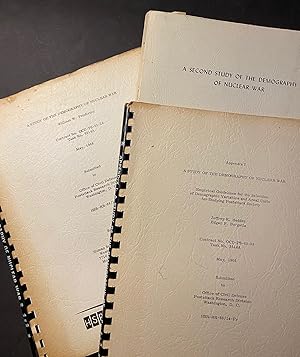
PENDLETON, William H. A Study of the Demography of Nuclear War. Human Sciences Research Inc., 1966. 11x8 inches, 103pp, gvc/plastic comb binding. Very good copy. Rare. Surprisingly: WorldCat/OCLC lists TWO copies. [++] Offered with: Appendix I, a Study of the Demography of Nuclear War, Empirical Guidelines for the Selection of Demographic Variables and Areal Units for Studying Postattack Society. By Jeffrey Hadden and Edgar Borgotta. Published by Human Sciences Research Inc. and submitted to the Office of Civil Defense, Postattack Research Division, May 1966 11x8, 16pp. GVC bound, very similar to the preceding. [+++] And offered with: PENDLETON. A Second Study of the Demography of Nuclear War. Published by Human Sciences Research Inc, and submitted to the U.S. Army and the Office of Civilian Defense. 11X8 , 141, xiiipp. Printed wrappers. Dated August, 1967. WorldCat/OCLC locates 16 copies. [++] Outside of its statistical foray in survivability and the procreative prospects of the left-overs of vast nuclear exchanges, the work is a solemn attempt at institutionalizing the death requirements of nuclear combat. The necessity of overwhelming carnage is presented in ironic and underwhelming language, the first bits of which are seen in the conclusion of pamphlet s abstract: Cities differ in the kinds and magnitudes of change to which they might be subjected. Considerable variation in the demography of surviving populations can be expected; that variation would be related to policy decisions; and those decisions should therefore be examined for their demographic implications. [++] Put another way, the city is the main focus of the survivability equations, and the chances of the humans being bombed in those cities would change with god help us the amount of bombing.Cities differ in the kinds and magnitudes of change to which they might be subjected. This is the key I think to understanding documents like this, making a simple foundation statement so convoluted and tortured that it and most of what follows make any sense outside of restating themselves. Which I guess is a strength. [++] According to one study [and for the sake of brevity I m not going to describe the scenarios or data estimation methods and so on] the U.S. would suffer 46% casualties [meaning immediate deaths and not as a result of radiation or illness or starvation or the encyclopedia of whatever that would lead to death somewhere down the road]. The resulting demographic of the perished by job description postulates that the most-killed category of worker would be: (#1) aeronautical engineers, 86% dead; (#2) transportation equipment salaried manager, with 79% killed; (#3), social scientists, with 78% of them going down with their clients; (#4), authors, with 76% gone. Authors? Of what, I wonder? The good ones with the bad? Are authors different from writers? And what do you call folks who produce tv shows? Since the stats here are for 70 cities there s no wonder that there aren t any farmers in this table, as the majority target areas (some 450 cities cited elsewhere as targetable, including my own little burgh of Asheville, N.C.) would naturally have city folk in them. And so I m guessing that three-quarters of all authors in 1960/6 were living in these target cities and were going to go up in smoke. The aeronautical engineers category is more understandable as every one of those industries employing 50 or more people would be a target; frankly I m surprised that given the possible firepower of the Soviet Union in 1966 that 14% would survive; I d guess offhand that the number would be 2%. Even though this stuff is spread out in only 98 pages or so it would keep a person busy segregating the Orwellian gems from those not; it would be a tricky business as most of the text in the not category would be largely limited to prepositions. .
Seller Inventory # ABE-1611704019725
Contact seller
Report this item