Synopsis
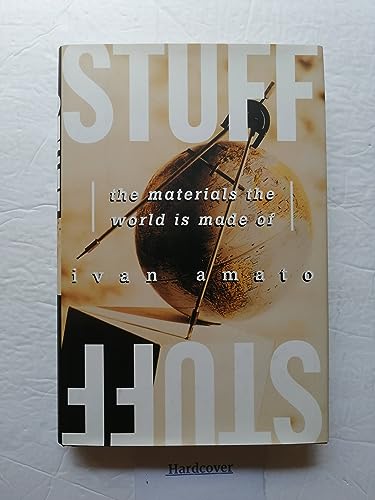
From plastics to smart materials to never-before-seen composites, scientists have transformed the raw materials of the wilderness into the stuff of the modern world. Now, award-winning journalist Ivan Amato explores this fascinating science.Prehistory was stuck in the Stone Age partly because it lacked the scientific know-how to smelt iron from rocky ores. The Industrial Revolution owed its birth to the geniuses who figured out how to make large amounts of steel. Postwar America can thank or hang in effigy John Wesley Hyatt, who gave us plastics. And twenty-first-century America may well rise, or fall, depending on how far ahead it remains in the development of smart materials. The most important factor in technological progress today is the ability of the materials scientist to take apart and reconfigure the physical stuff of the world into substances that have never existed naturally on Earth.Much more than a history of the material sciences, Stuff brims with interviews with cutting-edge experts in the field, many of whom are building new materials literally atom by atom, and describes such astounding achievements as artificial diamonds created from peanut butter and how nanotechnologists are building new-age, state-of-the-art machines no thicker than a few hundred atoms. Compelling and informative, it gives readers a marvelous glimpse into the modern world of technology and the smart materials that are at the forefront of tomorrow's breakthroughs in computers, military weaponry, electronics, and more.
Reviews
Materials science sees the world as fodder for new and better structural materials; here's an overview of this new discipline. Amato, whose articles have appeared in Science News and the Washington Post, begins by looking at the paper, ink, and glue of a printed book. These are highly refined products, the result of a long history of research and development, much of it by trial and error. Technological history, from flint-knapping through the smelting of ores to the development of synthetics in the 19th century, shows how our handling of natural raw materials has grown increasingly sophisticated. By the 20th century, scientists were learning how matter actually works on the atomic level: Quantum mechanics and electron microscopy offered hints as to why ceramic is brittle and graphite slippery, and how those characteristics might be altered or improved. The development of synthetic rubber during WW II showed the need for a coherent science of materials, combining the techniques and insights of many disciplines. The space program fueled the search for new, lighter, more resilient materials. Amato examines recent and projected developments in the field. Some researchers have created ceramics that mimic the microstructure of abalone shells; others are exploring ways to form artificial diamond into films, or to synthesize materials even harder than diamond. ``Smart'' materials--a familiar example is sunglass lenses that darken in brighter light--are among the hottest new areas of research. Other researchers are content to improve existing materials: Fiber-optic cables required glass of unprecedented transparency. Our technological future, Amato suggests, may be as far beyond our present as we are beyond the flint-knappers of Paleolithic times. It is a heady time for this new discipline, and Amato gives a good sense of its energy and potential. (illustrations, not seen) -- Copyright ©1997, Kirkus Associates, LP. All rights reserved.
It is a long time (2.5 million years) between the first hand axe and today's material design, but both concepts represent the same hominidal instinct to utilize raw materials to make life easier. With great enthusiasm and clarity, Amato scans the process of finding out what stuff does and then manufacturing something out of it. For ages the process was trial-and-error, but in the past 35 years, materials science has rocketed past hit-or-miss tinkering. Amidst this astounding wave of innovations, Amato steps in to explain the interlocking subspecialties of the field, such as metallurgy, ceramics, and biomimetics (invented materials that mimic biological tissues). Amato points out that the driving force of research is unlocking the microscopic causes of tangible properties and that the field has advanced to where materials can be designed according to the quantum behavior of electrons, which has yielded fantastic solid-state devices. Covering an area whose speciality journals announce an invention every issue, Amato provides an evocative general explanation of the engineers' excitement. Gilbert Taylor
Amato has drawn upon his experience covering science and technology topics for Science News and Science to write this history of materials science. In the book's first half, he traces the subject from Olduvai Gorge to Silicon Valley, chronicling the shift from largely serendipitous discoveries to steady improvements as the result of a trial-and-error approach. Amato then looks at today's cutting-edge materials research, in which new materials that never existed in the natural world (e.g., artificial diamonds made out of peanut butter) are being developed by design. Writing in a lively, readable style that will appeal to the nonexpert, Amato manages to convey his enthusiasm for the subject. The references at the end are largely bibliographic essays of books and articles suggested for further reading on each topic. Few other books cover the history of the discipline so succinctly or engagingly. Recommended for academic libraries and public libraries with strong science collections.?Wade Lee, Univ. of Toledo Libs.
Copyright 1997 Reed Business Information, Inc.
"About this title" may belong to another edition of this title.