Synopsis
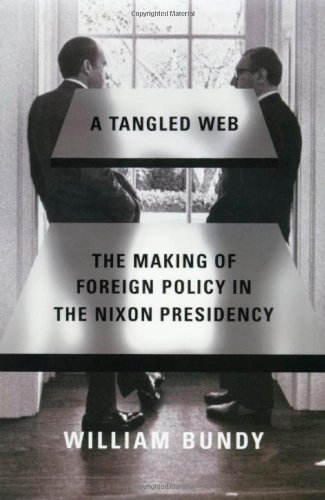
The first authoritative account of the Nixon-Kissinger record in its entirety, this book explores the details of their work in every aspect and their short-term gains and losses, in a clear assessment of the consequences of Nixon and Kissinger's operational modes. 15,000 first printing.
Reviews
A Tangled Web presents neither sensational revelations nor noteworthy archival findings; it is, instead, an impressive synthesis of secondary works and memoirs, and above all a response to Nixon's memoirs and Kissinger's two volumes on the 1969-74 period.... should provoke discussion on both sides of the barricades.
Bundy, a former adviser at the State and Defense Departments as well as the CIA under presidents Eisenhower and Kennedy, and editor of Foreign Affairs from 1972 to 1984, here recaps U.S. foreign policy during the Nixon era. He has a lot to say, some of it negative, about the role of Henry Kissinger as Nixon's special assistant for national security affairs, then as secretary of state. Bundy credits Nixon as a brilliant strategist who was undone by his tendency to exclude the public and Congress from his deliberations. He is less charitable to Kissinger, whom he describes as obsessed with control and often making errors of judgment when refusing to consult professionals at the State Department and failing to bring Congress into his confidence. Bundy takes a jaundiced view of the memoirs of both men in their respective depictions of what transpired in Vietnam and Cambodia, as well as what he describes as their self-serving accounts of the opening to China and relations with the Soviet Union. He does credit the Nixon Administration with successful policies in the Middle East, many negotiated by Kissinger, to defuse Arab-Israeli conflicts, and concedes that Nixon was a skillful maneuverer and an experienced analyst. He maintains that Nixon's foreign policy accomplishments were undone less by Watergate than by the president's obsession with secrecy and his practice of deception. Photos not seen by PW.
Copyright 1998 Reed Business Information, Inc.
Bundy was a second-tier policy maker in the escalation of the Vietnam War. This lengthy history, while covering the gamut of Nixonian foreign policy, harshly criticizes how Nixon and Kissinger handled the mess they inherited from Bundy, his brother McGeorge, and the rest of the best and brightest. From his opening, an analysis (probably the most complete so far published) of Nixon's and Johnson's mutual spying over the 1968 election-eve bombing halt, through the 1973 cease-fire, the author has little to recommend about the new president's ways for extricating the U.S. from the morass. Bundy views most dimly Nixon and Kissinger's circumvention of Washington's national security bureaucracies. That deceptiveness looms as the text's central theme--hence the title. Insightful, detailed, and none too praiseworthy of Nixon's foreign policy spectaculars, Bundy's account of his personalized approach to the leaders of China, the Soviet Union, and the Middle East should interest students of a time still contentious after 25 years. Gilbert Taylor
"About this title" may belong to another edition of this title.