
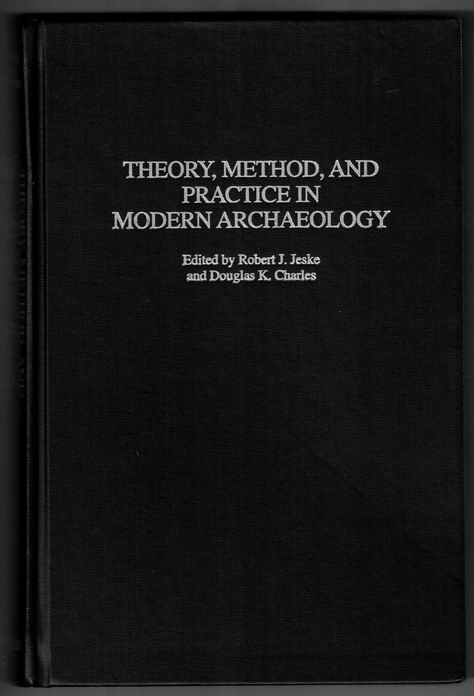
Theory, Method, and Practice in Modern Archaeology
Jeske, Robert J. & Douglas K. Charles (eds.)
ISBN 10: 089789748X ISBN 13: 9780897897488
Published by Praeger Publishers, 2003
Used
Hardcover
From
Aardvark Book Depot, Shorewood, WI, U.S.A.
Seller rating 5 out of 5 stars

Heritage Bookseller
AbeBooks member since 1996
This specific item is no longer available.
About this Item
Description:
9.5x6", xvi+392 pp. VG, clean & tight, no dj. Seller Inventory # 34625
Synopsis:
This book presents 18 essays by leading scholars covering mortuary analysis, the archaeology of foraging and agricultural societies, cultural evolution, and archaeological method and theory, which transcend the processual/postprocessual debate in archaeology and provide examples of how archaeologists think about, and go about, studying the past.
As archaeology encounters the 21st century, debate over the nature of the discipline dominates professional discourse. Archaeologists are embattled over isms: processualism, postprocessualism, scientism, and humanism are ubiquitous buzzwords in the literature. Yet archaeology is a craft practiced by individuals, learned from and influenced by other individuals. Sometimes a peson, through sheer force of intellectual spirit, rises above the debate to make a mark on the field in ways that cross out schools, paradigms, and factions.
It is fitting to look back at the influence one such individual has had on archaeological methods, theory, data collection, and syntheses over the last half century. This volume draws on the experience of students and colleagues who worked with and were strongly influenced by James A. Brown's approach to the past. The volume is divided into five categories, each reflecting one distinctive facet of Brown's affect on archaeology: mortuary analysis, foraging and horticultural societies, complex agriculturalists, proto-historic and historic societies, and method and theory. These diverse categories, with articles by archaeologists of many backgrounds, are drawn together by the threads of Brown's intellectual legacy. Not all authors here are in agreement with Brown's views on their subjects, but all acknolwedge that his work in the area sets a standard that needs to be met if one is to succeed.
About the Author:
ROBERT J. JESKE is Associate Professor of Anthropology at the University of Wisconsin, Milwaukee, and is Director of the Archaeological Research Laboratory.
DOUGLAS K. CHARLES is Professor and Chair of the Department of Anthropology at Wesleyan University.
"About this title" may belong to another edition of this title.
Bibliographic Details
Title: Theory, Method, and Practice in Modern ...
Publisher: Praeger Publishers
Publication Date: 2003
Binding: Hardcover
Top Search Results from the AbeBooks Marketplace

Stock Image
Theory, Method, and Practice in Modern Archaeology
Seller: Karen Wickliff - Books, Columbus, OH, U.S.A.
Seller rating 4 out of 5 stars

Hard Cover. Condition: Very Good. No Jacket. 392pp. Black cloth hardback, no DJ, VG, owner name on front end page and upper page edge, index, references, b&w photos, graphs, maps, figures and tables, Includes: Mortuary studies, Foraging and horticultural societies, Mississippian societies, Upper Mississippian and historic societies, Methods and theory, Seller Inventory # w231132913
Stock Image
Theory, Method, and Practice in Modern Archaeology
Seller: HPB-Red, Dallas, TX, U.S.A.
Seller rating 5 out of 5 stars
hardcover. Condition: Good. Connecting readers with great books since 1972! Used textbooks may not include companion materials such as access codes, etc. May have some wear or writing/highlighting. We ship orders daily and Customer Service is our top priority! Seller Inventory # S_262577593
Stock Image
Theory, Method, and Practice in Modern Archaeology
Print on DemandSeller: PBShop.store UK, Fairford, GLOS, United Kingdom
Seller rating 4 out of 5 stars
HRD. Condition: New. New Book. Delivered from our UK warehouse in 4 to 14 business days. THIS BOOK IS PRINTED ON DEMAND. Established seller since 2000. Seller Inventory # L1-9780897897488
Buy New
US$ 112.94
US$ 6.69 shipping
Ships from United Kingdom to U.S.A.
Ships from United Kingdom to U.S.A.
Quantity: Over 20 available
Stock Image
Theory, Method, and Practice in Modern Archaeology
Print on DemandSeller: PBShop.store US, Wood Dale, IL, U.S.A.
Seller rating 5 out of 5 stars
HRD. Condition: New. New Book. Shipped from UK. THIS BOOK IS PRINTED ON DEMAND. Established seller since 2000. Seller Inventory # L1-9780897897488
Stock Image
Theory, Method, and Practice in Modern Archaeology
Seller: Ria Christie Collections, Uxbridge, United Kingdom
Seller rating 5 out of 5 stars
Condition: New. In. Seller Inventory # ria9780897897488_new
Buy New
US$ 120.28
US$ 15.98 shipping
Ships from United Kingdom to U.S.A.
Ships from United Kingdom to U.S.A.
Quantity: Over 20 available
Stock Image
Theory, Method, and Practice in Modern Archaeology (Hardcover)
Published by
Bloomsbury Publishing Plc, Westport, 2003
ISBN 10: 089789748X
ISBN 13: 9780897897488
New
Hardcover
Seller: CitiRetail, Stevenage, United Kingdom
Seller rating 5 out of 5 stars
Hardcover. Condition: new. Hardcover. This book presents 18 essays by leading scholars covering mortuary analysis, the archaeology of foraging and agricultural societies, cultural evolution, and archaeological method and theory, which transcend the processual/postprocessual debate in archaeology and provide examples of how archaeologists think about, and go about, studying the past.As archaeology encounters the 21st century, debate over the nature of the discipline dominates professional discourse. Archaeologists are embattled over isms: processualism, postprocessualism, scientism, and humanism are ubiquitous buzzwords in the literature. Yet archaeology is a craft practiced by individuals, learned from and influenced by other individuals. Sometimes a peson, through sheer force of intellectual spirit, rises above the debate to make a mark on the field in ways that cross out schools, paradigms, and factions.It is fitting to look back at the influence one such individual has had on archaeological methods, theory, data collection, and syntheses over the last half century. This volume draws on the experience of students and colleagues who worked with and were strongly influenced by James A. Brown's approach to the past. The volume is divided into five categories, each reflecting one distinctive facet of Brown's affect on archaeology: mortuary analysis, foraging and horticultural societies, complex agriculturalists, proto-historic and historic societies, and method and theory. These diverse categories, with articles by archaeologists of many backgrounds, are drawn together by the threads of Brown's intellectual legacy. Not all authors here are in agreement with Brown's views on their subjects, but all acknolwedge that his work in the area sets a standard that needs to be met if one is to succeed. As archaeology encounters the 21st century, debate over the nature of the discipline dominates professional discourse. Archaeologists are embattled over "isms": processualism, postprocessualism, scientism, and humanism are ubiquitous buzzwords in the literature. Yet archaeology is a craft practiced by individuals, learned from and influenced by other individuals. Sometimes a peson, through sheer force of intellectual spirit, rises above the debate to make a mark on the field in ways that cross out schools, paradigms, and factions. It is fitting to look back at the influence one such individual has had on archaeological methods, theory, data collection, and syntheses over the last half century. This volume draws on the experience of students and colleagues who worked with and were strongly influenced by James A. Brown's approach to the past. The volume is divided into five categories, each reflecting one distinctive facet of Brown's affect on archaeology: mortuary analysis, foraging and horticultural societies, complex agriculturalists, proto-historic and historic societies, and method and theory. These diverse categories, with articles by archaeologists of many backgrounds, are drawn together by the threads of Brown's intellectual legacy. Not all authors here are in agreement with Brown's views on their subjects, but all acknolwedge that his work in the area sets a standard that needs to be met if one is to succeed. This item is printed on demand. Shipping may be from our UK warehouse or from our Australian or US warehouses, depending on stock availability. Seller Inventory # 9780897897488
Buy New
US$ 120.86
US$ 49.34 shipping
Ships from United Kingdom to U.S.A.
Ships from United Kingdom to U.S.A.
Quantity: 1 available
Seller Image
Theory, Method, and Practice in Modern Archaeology
Print on DemandSeller: moluna, Greven, Germany
Seller rating 4 out of 5 stars
Condition: New. Dieser Artikel ist ein Print on Demand Artikel und wird nach Ihrer Bestellung fuer Sie gedruckt. Über den AutorROBERT J. JESKE is Associate Professor of Anthropology at the University of Wisconsin, Milwaukee, and is Director of the Archaeological Research Laboratory.DOUGLAS K. CHARLES is Professor and Chair of the Depar. Seller Inventory # 447102672
Buy New
US$ 126.10
US$ 56.84 shipping
Ships from Germany to U.S.A.
Ships from Germany to U.S.A.
Quantity: Over 20 available
Seller Image
Theory, Method, and Practice in Modern Archaeology
Print on DemandSeller: preigu, Osnabrück, Germany
Seller rating 5 out of 5 stars
Buch. Condition: Neu. Theory, Method, and Practice in Modern Archaeology | Robert Jeske (u. a.) | Buch | Gebunden | Englisch | 2003 | Praeger | EAN 9780897897488 | Verantwortliche Person für die EU: Libri GmbH, Europaallee 1, 36244 Bad Hersfeld, gpsr[at]libri[dot]de | Anbieter: preigu Print on Demand. Seller Inventory # 102387689
Buy New
US$ 130.79
US$ 81.21 shipping
Ships from Germany to U.S.A.
Ships from Germany to U.S.A.
Quantity: 5 available
Stock Image
Theory, Method, and Practice in Modern Archaeology
Print on DemandSeller: THE SAINT BOOKSTORE, Southport, United Kingdom
Seller rating 5 out of 5 stars
Hardback. Condition: New. This item is printed on demand. New copy - Usually dispatched within 5-9 working days. Seller Inventory # C9780897897488
Buy New
US$ 131.07
US$ 24.18 shipping
Ships from United Kingdom to U.S.A.
Ships from United Kingdom to U.S.A.
Quantity: Over 20 available
Stock Image
Theory, Method, and Practice in Modern Archaeology (Hardcover)
Published by
Bloomsbury Publishing Plc, Westport, 2003
ISBN 10: 089789748X
ISBN 13: 9780897897488
New
Hardcover
Seller: Grand Eagle Retail, Bensenville, IL, U.S.A.
Seller rating 5 out of 5 stars
Hardcover. Condition: new. Hardcover. This book presents 18 essays by leading scholars covering mortuary analysis, the archaeology of foraging and agricultural societies, cultural evolution, and archaeological method and theory, which transcend the processual/postprocessual debate in archaeology and provide examples of how archaeologists think about, and go about, studying the past.As archaeology encounters the 21st century, debate over the nature of the discipline dominates professional discourse. Archaeologists are embattled over isms: processualism, postprocessualism, scientism, and humanism are ubiquitous buzzwords in the literature. Yet archaeology is a craft practiced by individuals, learned from and influenced by other individuals. Sometimes a peson, through sheer force of intellectual spirit, rises above the debate to make a mark on the field in ways that cross out schools, paradigms, and factions.It is fitting to look back at the influence one such individual has had on archaeological methods, theory, data collection, and syntheses over the last half century. This volume draws on the experience of students and colleagues who worked with and were strongly influenced by James A. Brown's approach to the past. The volume is divided into five categories, each reflecting one distinctive facet of Brown's affect on archaeology: mortuary analysis, foraging and horticultural societies, complex agriculturalists, proto-historic and historic societies, and method and theory. These diverse categories, with articles by archaeologists of many backgrounds, are drawn together by the threads of Brown's intellectual legacy. Not all authors here are in agreement with Brown's views on their subjects, but all acknolwedge that his work in the area sets a standard that needs to be met if one is to succeed. As archaeology encounters the 21st century, debate over the nature of the discipline dominates professional discourse. Archaeologists are embattled over "isms": processualism, postprocessualism, scientism, and humanism are ubiquitous buzzwords in the literature. Yet archaeology is a craft practiced by individuals, learned from and influenced by other individuals. Sometimes a peson, through sheer force of intellectual spirit, rises above the debate to make a mark on the field in ways that cross out schools, paradigms, and factions. It is fitting to look back at the influence one such individual has had on archaeological methods, theory, data collection, and syntheses over the last half century. This volume draws on the experience of students and colleagues who worked with and were strongly influenced by James A. Brown's approach to the past. The volume is divided into five categories, each reflecting one distinctive facet of Brown's affect on archaeology: mortuary analysis, foraging and horticultural societies, complex agriculturalists, proto-historic and historic societies, and method and theory. These diverse categories, with articles by archaeologists of many backgrounds, are drawn together by the threads of Brown's intellectual legacy. Not all authors here are in agreement with Brown's views on their subjects, but all acknolwedge that his work in the area sets a standard that needs to be met if one is to succeed. This item is printed on demand. Shipping may be from multiple locations in the US or from the UK, depending on stock availability. Seller Inventory # 9780897897488